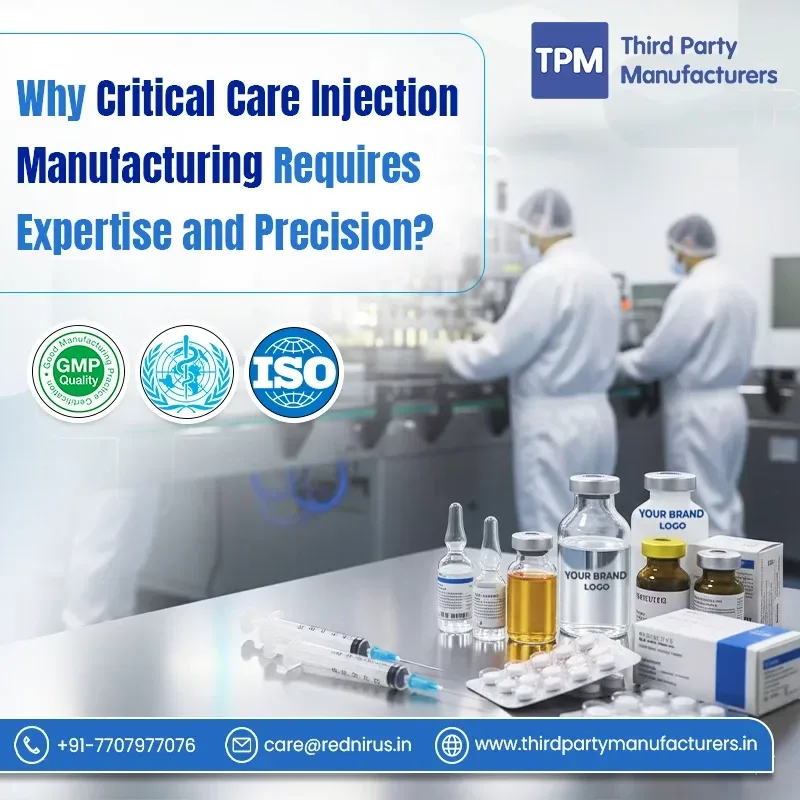
Critical care injections hold up a big part of the health system, because they go to patients fighting dangerous illness. The ICU is the most demanding department in any hospital, and when doctors there carry out life-saving work they depend on an injection that acts fast and is made without a single error. That is why making them calls for real professional skill and modern technology. Quality control has to be very strict.
Ordinary medicines face a lower bar. Critical care injection makers in India have to guarantee sterility and stability, and purity on top of that. A small mistake in the material or the dose can put a patient's life at risk. So this work is left to highly skilled manufacturers who can handle a complicated process.
Let's see why this stage needs so much precision, and why only people who really know critical care production can pull it off.
Why Critical Care Injection Manufacturing Needs Precision and Expertise?
Making these injections is far more than mixing chemicals. Each dose has to be safe and it has to work. The Critical Care Injection Manufacturing process runs through several stages: formulation first, then sterilisation, and after that the filling of ampoules or vials before the final packing, which is where a careless line can undo everything done upstream. Every one of them needs careful hands and good machines.
Here is why precision and expertise matter so much:
1. Sterility and Safety Come First
- Injections go straight into the bloodstream. Even a tiny bit of contamination can harm.
- A careless manufacturer in India that doesn't follow Good Manufacturing Practice (GMP) properly puts sterility at serious risk.
- Well-kept sterile areas with good air filtration, and microbial tests done often, are how sterility is actually achieved.
2. Accurate Dosage and Formulation
- Critical care medicines must act quickly and give exactly the intended result.
- High-end critical care makers use advanced systems that measure ingredients down to the microscopic level.
- Even a small change in composition can affect how the patient heals, so precision comes first.
3. Quality Testing and Approval
- Every batch has to clear strict quality testing before it's approved.
- That means sterility and stability tests, along with pH checks, which confirm the injection is safe and effective.
- Only reliable third party makers with well-equipped labs can carry out testing like this.
4. Regulatory Compliance and Certification
- Third Party Manufacturers of Critical Care injections have to meet WHO and GMP norms as well as ISO standards.
- Meeting them shows the maker is honest and the products are safe to use.
- Regulatory inspections also confirm that the injections meet the standards of Indian and foreign markets.
How Do Third Party Manufacturers Maintain Quality in Critical Care Injections at Its Best?
Many pharma companies hand this work to third party plants because it's cost-effective and output stays consistent from one order to the next, but the arrangement only works when the manufacturer already has a proven record with high-risk products. Check that record.
This is how good critical care contract makers keep their quality high.
1. Modern Manufacturing Setup
- They run automatic filling lines inside filtered clean rooms, backed by advanced filtration systems.
- The product stays sterile for its entire life.
2. Strong Technical Teams
- Qualified staff watch over every manufacturing cycle so formulations come out accurate.
- Their know-how keeps quality at the level medical standards demand.
3. Regular Quality Audits
- Internal and external audits check that the plant keeps meeting GMP norms.
- Ongoing assessment is what keeps the better Critical Care Injection Manufacturers in India ahead on quality.
4. Research and Development
- Constant improvement changes how medicines are made and packed. It also helps them stay stable and last longer.
- Indian makers of critical care products put a large share of their investment into R&D so the products get better and safer.
Why Indian Manufacturers Excel in Critical Care Injection Manufacturing?
India has become a global hub for critical care injections, thanks to well-developed infrastructure and a very capable workforce. Indian makers are known for supplying high quality medicines at an affordable cost.
These are the reasons India leads in this field.
1. Lower Cost, Better Quality
- Good quality production happens here at a much lower cost, which draws global pharma players.
- Outsourcing this work to Indian plants keeps quality secure and brings costs down.
2. Strong Supply Chain Network
- Most Indian manufacturers have large distribution networks across the country, so deliveries arrive on time.
- They make dependable partners.
3. Government Support and Helpful Regulations
- Government policy helps pharma exports and encourages new work in this important industry.
- Critical Care Injection Third Party Manufacturers gain from simpler licensing and from export support.
Focus on Innovation and Technology
- Progress in sterile filling and validation, and in quality assurance, has opened doors for Indian players.
- It means every injection can meet international healthcare standards.
FAQs
Q1: Why does expertise matter so much when making critical care injections?
A1: Skilled people make sure each injection is clean and safe. It must also work exactly as the doctor expects. The process uses advanced machines and methods that only trained professionals can run correctly.
Q2: How do Third Party Manufacturers keep products safe?
A2: Their facilities are GMP-certified with sterile environments, and they run quality tests regularly to confirm safety and compliance.
Q3: Are Indian Critical Care Injection Manufacturers good quality for export to the international markets?
A3: Yes. Many critical care injection makers in India export, and goods made for export follow WHO-GMP standards.
Conclusion
This is specialised work. It depends on high-tech equipment and on people who know how to run it. Done in your own plant or through a third party, every step has to meet the highest standard of safety and quality, every time. Indian makers have put themselves at the front of the field with strong infrastructure and a well-trained workforce. Their focus on new methods and on quality is what gets genuine, well-tested medicines delivered to patients in India and around the world.
Read More: How to Select Best Third Party Injection Manufacturers?
Why Critical Care Injection Manufacturing Needs Precision and Expertise?
The manufacturing process of the injections in critical care is not just blending chemicals—it is also an assurance that each dose is not only safe but also effective. The Critical Care Injection Manufacturing process takes a number of steps such as formulation, sterilization, filling, and packaging.
Critical Care Injection Production is the pillar of the health care system, since these medicines are primarily administered to heal individuals suffering from risky diseases. As the intensive care unit is the most critical department within the hospital, and physicians carry out life-saving interventions, all thanks to the injection that is quick and error-free. Therefore, the production of such goods requires advanced professional expertise, modern technologies, and extremely strict quality control procedures. Unlike regular medicines, Critical Care Injection Manufacturers in India need to have the assurances of sterility, stability, and purity. A little error in either material or dosage...
Key takeaways
- Why Critical Care Injection Manufacturing Needs Precision and Expertise?
- How Do Third Party Manufacturers Maintain Quality in Critical Care Injections at Its Best?
- Why Indian Manufacturers Excel in Critical Care Injection Manufacturing?
How to order Why Critical Care Injection Manufacturing Requires Expertise and Precision?
- Define the product Fix the composition, dosage form, pack size, quantity and your brand name.
- Shortlist manufacturers Compare WHO-GMP certification, product permission, capacity and location.
- Compare quotations Ask for the per-unit rate, MOQ, lead time and packing material cost in writing.
- Approve artwork and sample Finalise label, carton and MRP, and approve the pre-production sample.
- Receive your batch Pay the agreed advance and receive goods with invoice and certificate of analysis.