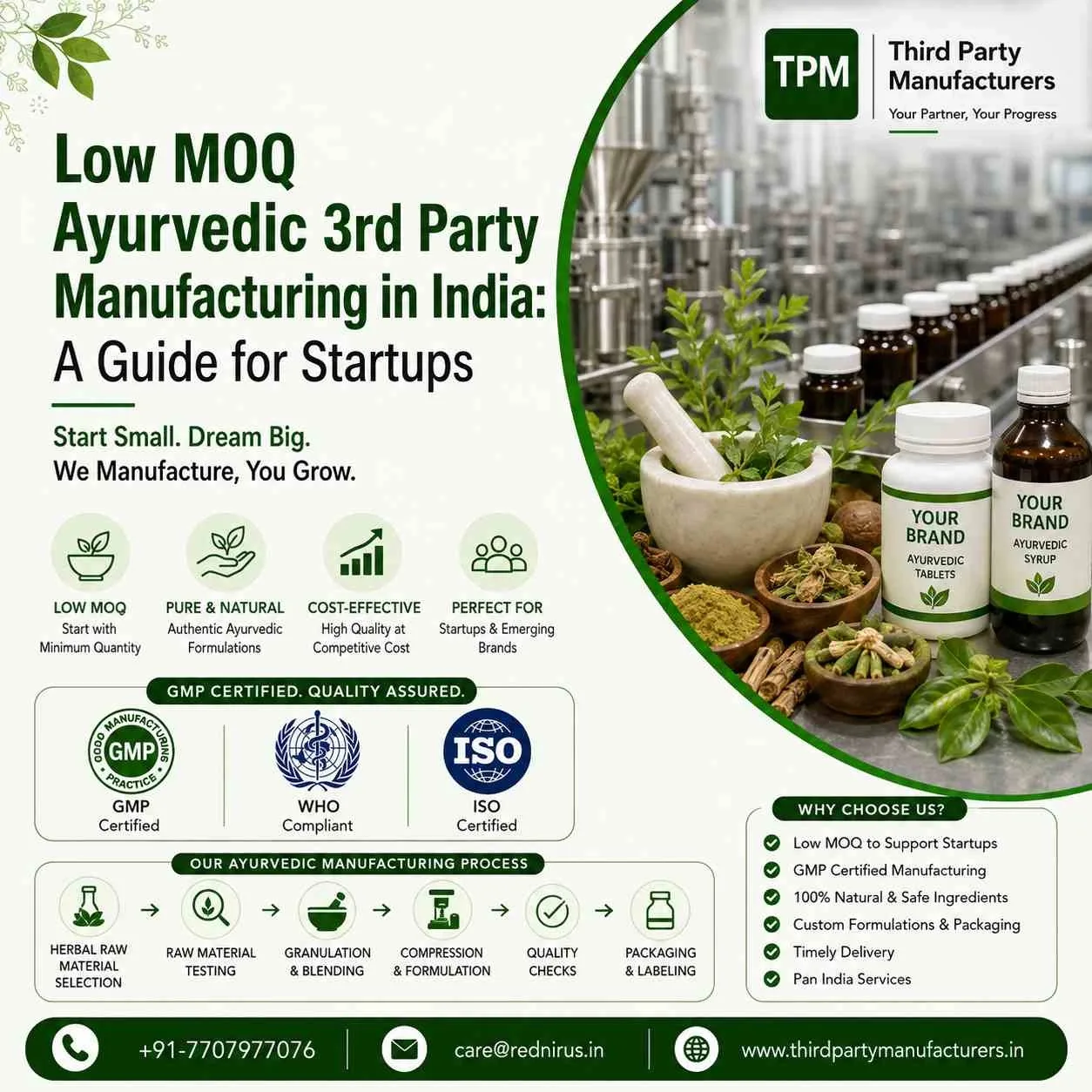
Low MOQ Ayurvedic 3rd Party Manufacturing in India lets a startup make Ayurvedic products in small quantities without sinking money into a plant. You can test the market and keep inventory risk down. Products go out one by one, while the manufacturer handles formulation, production, packing and quality compliance.
For today's wellness founders, getting products made by an Ayurvedic contract unit is the easy way to grow a range without owning a single machine. Rather than putting crores into a GMP certified unit, you tie up with a reputed maker that already has the formulations and the equipment, and the certificates as well. This route has opened herbal products to entrepreneurs and wellness influencers. Dieticians use it, as do home-grown startups that began with nothing more than one hero product and a small following. The best part is that MOQs have come down. A founder no longer has to spend lakhs of rupees booking a full production batch just to see if an idea sells. That one change has made the whole model far easier to try.
What is Ayurvedic 3rd Party Manufacturing and Why Startups are Choosing It?
In plain words, a manufacturer makes herbal products for a brand, under that brand's name. That can mean capsules, syrups, oils or skincare. People call it Ayurvedic Contract Manufacturing, or Ayurvedic medicine third party manufacturing. The maker sources raw herbs and formulates the product, then makes it. Testing and packing are its job too. The brand handles sales and distribution.
That's exactly why so many startups go to a third party Ayurvedic maker instead of building a factory. Your own unit would need WHO-GMP compliant infrastructure and an Ayurvedic pharmacist on staff, plus a manufacturing licence under the Drugs and Cosmetics Act. Machinery upkeep eats money too. It makes no sense for a young startup. Working with a running Ayurvedic Manufacturing Company frees your money for branding and marketing.
None of this is new to Indian pharma. Allopathic medicine has used third party manufacturing for years. The herbal side has simply adapted it. The core idea is the same as 3rd Party Pharma Manufacturing: production goes to a specialist unit while the brand keeps full control of product identity and marketing. So someone who already knows pharma distribution can move into herbal and Ayurvedic lines without much trouble.
Why Low MOQ Matters for New Ayurvedic Brands?
MOQ is usually the biggest hurdle for a new brand. Older Ayurvedic units asked for huge batches of 10,000 units or more per SKU. Founders had to raise serious money at the start, or drop good product ideas. That's changed. A growing number of herbal makers doing Third Party Manufacturing now accept much smaller batches, as low as 500 to 1000 units.
It opens doors. You can test three or four formulations in small lots, see which ones sell and then make only those. Less money is wasted and there's no dead stock. You can also respond quickly when customers ask for something different. Solo founders and small teams with no investor behind them, just a product idea and a clear target buyer, can now get into the market.
There's a cash flow benefit founders often miss. Money spent on a large production run stays locked up for months, especially before your supply chain is in place. With a low MOQ, that same money can go into packaging or influencer tie-ups, or into performance marketing. In the early days any of those can move revenue far more than extra stock sitting in a godown.
How to Choose the Right Third Party Ayurvedic Manufacturing Company?
Not every maker offering a low MOQ gives you good quality. Check them. When you pick a Third Party Medicine Manufacturer, look at the facility's certificates and the clients it has worked for, and ask if it will run sample batches before the main order. A genuine unit will explain its manufacturing licences without fuss. It will tell you where the raw material comes from and how lab testing is done. It won't mind you visiting the plant either.
Find out what the unit is best at. Some focus on classical Ayurvedic medicines like churna and tablets, or syrups. Others do herbal cosmetics: face washes, hair oils, body lotions. Matching the maker to your product type cuts formulation mistakes. Also check client feedback and GST registration, and the turnaround time a Third Party Manufacturing Ayurvedic Product partner can actually deliver.
People forget communication. A maker who replies fast, gives you a real timeline and keeps you posted on your order is much easier to work with than a slightly cheaper one who's hard to reach. Founders who've done well often say a good manufacturer acts like a co-pilot in the early months rather than a plain vendor, guiding you on packaging and expiry dating as well as export issues.
Range of Products You Can Launch Through Ayurvedic Contract Manufacturing
A big plus of this model is how many products a startup can launch without touching production. Classical formulas include churna, kwath, arishta, asava, bhasma and guggulu tablets, used for digestion and immunity or for joint problems. Beyond those, a Herbal Manufacturing Company will usually offer wellness capsules, herbal syrups and protein or nutraceutical blends. Functional teas too.
Personal care is growing fast too. Startups often go to Ayurvedic skin care makers for face packs, herbal soaps, anti-acne gels, bhringraj or amla hair oils and organic sunscreens. As buyers look for chemical-free products, this has become one of the busiest corners of herbal contract work. A good partner should be willing to tweak a formula's fragrance or texture, or its actives, so it fits your brand.
Certifications, Quality Standards, and Compliance to Check
Quality is where first-time founders most often underestimate the work involved. A genuine unit doing Third Party Pharma Manufacturing and herbal products should hold WHO-GMP and ISO certificates, and the AYUSH Premium Mark where it applies. Those tell you the raw material is tested for heavy metals and microbes. They also tell you batch details are recorded properly and finished goods get stability tested before dispatch.
Your new company also needs the right licence. That's the D&C Act licence for medicines, or one under the relevant cosmetic rules for a skin or hair care range. A responsible Ayurvedic Third Party Manufacturer gives a certificate of analysis (COA) with every batch and shows test results whenever you ask. Skip this to save time and you may pay later. Think regulatory action against your company. Think lost customer trust if a product fails quality tests after launch. Picking the best maker for your speciality is about holding quality, not about the lowest quote.
Steps to Start Your Partnership with an Ayurvedic Manufacturer
Once you get how it works, the early stages follow a set order. Start by fixing the product concept and category (classical medicine, nutraceuticals or personal care). Next, shortlist two or three units that do Ayurvedic Products Manufacturing on low MOQ terms and ask each for its catalogue and rates, with copies of certificates. Then get samples. Check texture, aroma, packaging and shelf life before you lock the formula.
Happy with the samples? Negotiate MOQ and price per unit, along with payment terms and delivery period, and put it all in a manufacturing agreement. Many founders register the brand name and file for a trademark at this point, since the maker will print your packaging to order. Then comes the first production run. Stay in touch with the maker for regular updates. That first lot of stock tells you how real the demand is before you reorder.
Frequently Asked Questions
Q1. What is the general low MOQ for Ayurvedic manufacturers nowadays?
Most makers now take orders of five hundred to one thousand units per SKU, compared with the older norm of a few thousand. Startups can trial products without much money at risk.
Q2. Is there any regulation for Ayurvedic 3rd Party Manufacturing in India?
Yes. It comes under the Drugs and Cosmetics Act and the AYUSH rules. Both the maker and the brand need licences before they sign a manufacturing deal.
Q3. Is it possible for a startup to use the same manufacturer for its skin care products?
Some units make both kinds of products. You're usually better off with one that specialises in your product type, though.
Conclusion
Low MOQ Ayurvedic 3rd Party Manufacturing has changed how wellness brands get built in India. Founders can try ideas, launch several SKUs and grow in step with real demand instead of being pushed into one big production run. You may start with classical formulas, nutraceuticals or herbal skincare. Whatever the line, the most important call you'll make is picking a certified partner who's open about how they work.
Must Read: Regulatory Updates Affecting Pharmaceutical Third Party Manufacturing in 2026-27
What is Ayurvedic 3rd Party Manufacturing and Why Startups are Choosing It?
In layman's terms, Ayurvedic 3rd Party Manufacturing is the manufacturing of herbal products, capsules, syrups, oils, and skincare products for that particular brand with its brand name. This kind of manufacturing process is termed as Ayurvedic Contract Manufacturing or Ayurvedic Medicine 3rd Party Manufacturing.
Low MOQ Ayurvedic 3rd Party Manufacturing in India allows startups to produce Ayurvedic products in smaller quantities without investing heavily in manufacturing infrastructure. It supports market testing, reduces inventory risks and enables businesses to launch products gradually while working with manufacturers for formulation, production, packaging and quality compliance. Ayurvedic 3rd Party Manufacturing is now the easy way for modern day wellness founders to expand the product range without needing to own a single piece of equipment. Instead of investing crores in setting up a GMP certified unit, one could simply team up with a reputed unit that already possesses the right formulations,...
Key takeaways
- What is Ayurvedic 3rd Party Manufacturing and Why Startups are Choosing It?
- Why Low MOQ Matters for New Ayurvedic Brands?
- How to Choose the Right Third Party Ayurvedic Manufacturing Company?
- Range of Products You Can Launch Through Ayurvedic Contract Manufacturing
- Certifications, Quality Standards, and Compliance to Check
- Steps to Start Your Partnership with an Ayurvedic Manufacturer
How to order Low MOQ Ayurvedic 3rd Party Manufacturing in India: A Guide for Startups
- Define the product Fix the composition, dosage form, pack size, quantity and your brand name.
- Shortlist manufacturers Compare WHO-GMP certification, product permission, capacity and location.
- Compare quotations Ask for the per-unit rate, MOQ, lead time and packing material cost in writing.
- Approve artwork and sample Finalise label, carton and MRP, and approve the pre-production sample.
- Receive your batch Pay the agreed advance and receive goods with invoice and certificate of analysis.