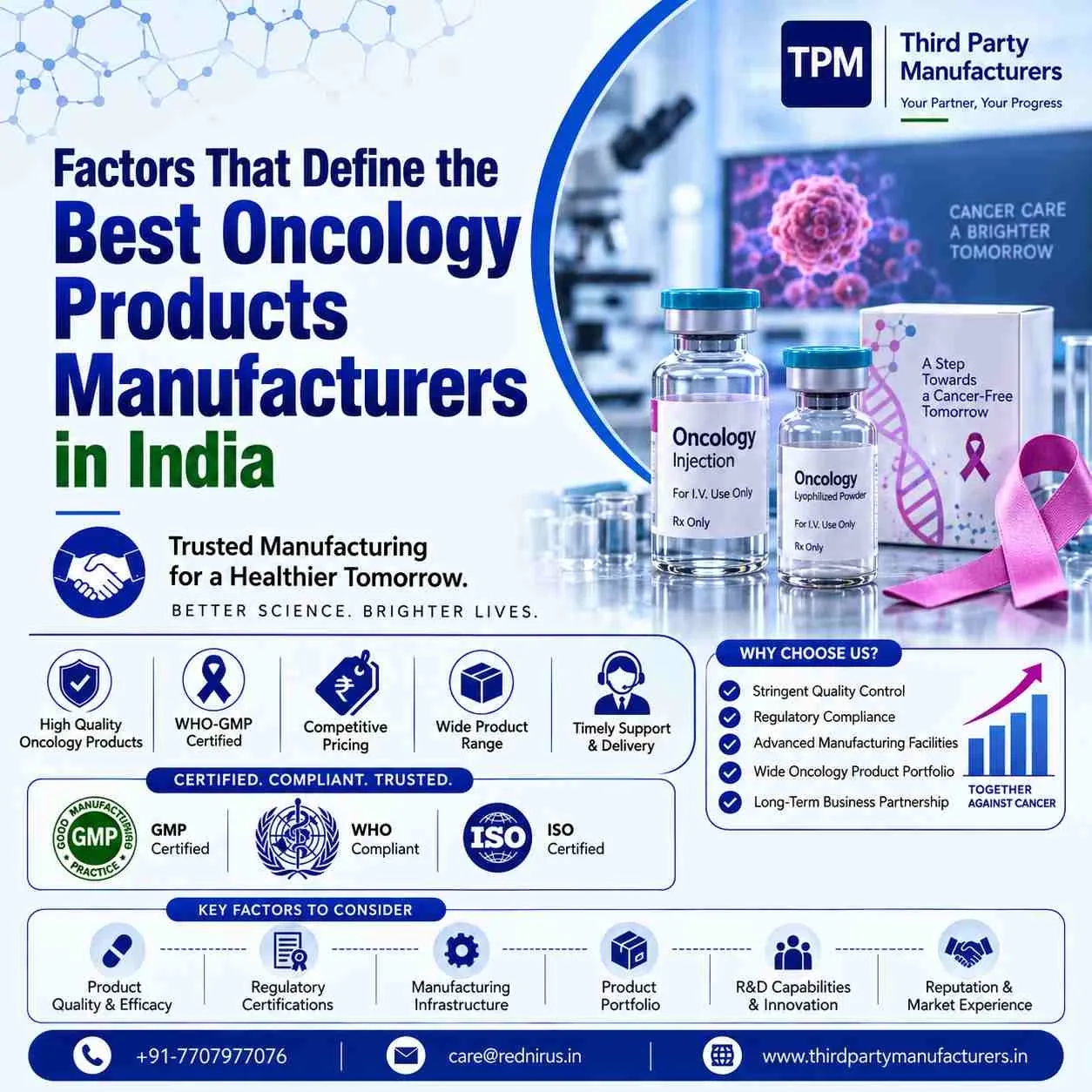
What makes the best Oncology Products Manufacturers in India stand apart? Mostly it comes down to product quality and regulatory compliance, backed by sound manufacturing standards, real research capability, a decent therapeutic range and supply you can count on. The good ones follow Good Manufacturing Practices (GMP), keep quality control tight, run validated processes and keep oncology medicines in stock month after month.
Indian Oncology Products Manufacturers have done a lot to build the country's name as a source of affordable cancer medicines of assured quality. That reputation now reaches well past Indian hospitals into export markets. Cancer cases keep rising in urban and semi-urban India, and that has pushed these companies to spend heavily on separate infrastructure and trained technical staff, because the cytotoxic material used in these medicines can't be handled like a paracetamol tablet. Most pharma plants simply can't meet those requirements, whatever their tablet or syrup volumes look like, and so they stay well away from oncology work. If you're a franchise partner, a hospital, a distributor or an overseas buyer sizing up possible partners, you need to know what really separates a capable maker from an average one before you sign anything or place a bulk order.
Understanding What Sets Leading Oncology Products Manufacturers
Strip it down and the gap between an average unit and a reliable name among Oncology Products Manufacturers is about how seriously the company takes risk. Cancer drugs punish shortcuts badly. A contamination event, a dosing mistake or a failed stability study does far more damage here than it would with an ordinary generic. That's why the better oncology pharma companies build their whole operation around containment and traceability. Paperwork gets the same weight. None of it is a box to tick before an audit.
There's another habit the top Oncology Pharmaceutical Companies share. They spend as much on training people as on buying machines. Staff handling cytotoxic and cytostatic material have to understand air flow and protective clothing. They must also know how waste gets neutralised. When you visit a plant, look past the certificates framed in reception. Ask how often operators are retrained. Ask how batch deviations get handled, and what the company does when something goes wrong (it will, sooner or later), because the answer tells you more than any brochure.
Hospital purchase teams and franchise partners also expect a manufacturer to explain its own process in plain words. Jargon won't do. Openness about batch records, the source of the API and the test methods used has become a handy filter. It shows you which firms actually understand oncology work, and which ones have just bolted it onto an existing generic line without changing their systems.
WHO-GMP Compliance and Regulatory Standing Among Cancer Pharmaceutical Companies?
With Cancer Pharmaceutical Companies, regulatory credibility isn't up for negotiation. WHO-GMP certification, Schedule M approval and a valid Certificate of Pharmaceutical Product (CoPP) are the starting point, not something that sets a company apart. What does say a lot is how a firm keeps those approvals alive over the years. Some treat an audit as a hurdle they clear once. The better ones run their own internal audit cycles and catch problems before an outside inspector walks in.
Oncology firms that supply government tenders, hospital chains or export buyers face extra checks on top of that: batch release testing, environmental monitoring logs and validated cleaning between cytotoxic product changeovers. Distributors and franchise partners should ask to see recent inspection reports. Don't rely only on the issue date printed on a certificate, since a plant's standing can slip between renewals depending on how it's run day to day.
Manufacturing Infrastructure and Quality Systems in Cancer Medicine Manufacturing
Making oncology medicines is nothing like making a regular injection or syrup batch, and any plant head who has done both will say so. Most cancer molecules are cytotoxic, meaning they damage healthy cells too if anyone is exposed to them. That's the reason the best Cancer Medicine Manufacturers keep separate, segregated blocks with their own air handling units, apart from the lines used for other medicines.
Hardware alone proves little. A genuine set of Third Party Manufacturers will have proper change control, validated cleaning-in-place routines and stability chambers that follow each product under real-time and accelerated conditions. Oncology formulations react badly to heat. Injectables and lyophilised vials are the worst, and the damage can happen in transit as easily as on the shop floor. A maker that can show solid in-house testing plus transport validation data is a much safer bet for anyone selling or dispensing the product further down the chain.
Product Portfolio Strength Among Oncology Medicine Manufacturers and Oncology Drug Manufacturers
A wide, well-run portfolio is one of the clearest signs of technical maturity. Established Oncology Medicine Manufacturers usually offer injection lines and oral tablet or capsule packs alongside targeted therapy molecules, with biosimilars now creeping into many lists. Each of these segments needs its own formulation skill and its own equipment. A company that only makes a thin band of old, off-patent molecules may be technically sound. It just won't do much for a partner's long-term growth.
Pipeline matters. Watch how Oncology Drug Manufacturers handle their molecule pipeline too. Treatment protocols in cancer change fast. Makers who keep track of newer classes such as hormonal therapies or monoclonal antibodies (and targeted small molecules) tend to stay on prescribers' lists and hospital formularies for longer. That helps franchisees and distributors directly, since a manufacturer's ability to launch new molecules in step with clinical practice often decides whether a portfolio still earns money five to ten years into the partnership.
Packing is no small thing here. Vial integrity, tamper-proof seals, cold chain ready packs for temperature-sensitive injectables and clear labels in more than one language all cut down on mishandling during shipment. A maker that pays attention to these back-end details is usually just as careful at the front end.
Export Credentials and Global Reach of Anti Cancer Medicine Exporters
India is one of the main global suppliers of low-cost cancer drugs, and that position leans heavily on the credibility of Anti Cancer Medicine Exporters. Buyers across Africa and the CIS region rely on oncology products made here, and so do buyers in Southeast Asia and Latin America. That trust rests on paperwork. Think USFDA and EU-GMP approvals where they apply, registration dossiers prepared for each destination country, and steady batch-to-batch quality that holds up over long sea routes and changing climates.
Dependable anti cancer product makers also keep their own regulatory affairs teams to put together country-specific registration files. Export rules differ a great deal between markets with strict pharmacovigilance and those with lighter registration. A manufacturer that handles both well, without cutting corners in either, has the kind of depth that small export-only players often don't.
Third Party and Contract Manufacturing Support for Franchise and Export Partners
A big share of India's oncology output moves through third party deals, so this part deserves a separate look. In simple terms, anti cancer third party manufacturers lend their facilities and certifications to partner brands, along with their GMP processes. That lets franchisees and distributors sell cancer medicines under their own name without owning a plant.
Good contract makers in this space earn their place by giving proper documentation, quoting realistic production timelines and even helping clients with regulatory forms. Done properly, third party oncology work is more than filling orders. It means a COA with every batch, early warning when supply gets tight, and consistent packing that protects the partner brand's name with hospitals and oncologists.
Third party and Anti Cancer Products Manufacturing deals work best when both sides see a long-term partnership, not a one-off order. Judge a manufacturer's responsiveness right at the enquiry stage. If they're slow to reply before the contract is signed, it won't get better afterwards.
Commonly Asked Questions (FAQs)
Q1. Which credentials should I check before tying up with an oncology supplier?
At the very least, the supplier should hold WHO and GMP certification plus a CoPP. Schedule M compliance is a must too. For exports, check that the maker has USFDA and EU-GMP approvals wherever the target market asks for them.
Q2. Why does cancer medicine production need dedicated infrastructure?
Oncology products are cytotoxic, so they have to be made in units kept apart from other products. Sharing a production line with ordinary medicines creates serious health and quality risks.
Q3. How does outsourcing production help a franchise business?
You get to use a manufacturer's existing certifications and facilities instead of building your own. Investment stays low, and you still enter the oncology market under your own label.
Conclusion
Picking a partner from the many Oncology Products Manufacturers out there isn't as easy as comparing price lists. The makers with a steady track record see regulatory compliance, containment, product depth and export paperwork as linked parts of one system, not separate check boxes. A franchise operator looking for a supplier, a distribution firm that needs exportable stock and a hospital buyer focused on quality all end up asking the same thing: does this manufacturer have the discipline oncology demands? Check the plant and its regulatory record before you commit. Check how they communicate as well. It pays off many times over.
Must Read: Best Syrup Manufacturing in India: Manufacturing Process, Benefits & Costs
What should you know about Factors That Define the Best Oncology Products Manufacturers in India?
The factors that define the best Oncology Products Manufacturers in India include product quality, regulatory compliance, manufacturing standards, research capabilities, therapeutic range and supply reliability. Leading manufacturers typically follow Good Manufacturing Practices (GMP), maintain strict quality control, use validated processes and ensure consistent availability of oncology medicines.
The factors that define the best Oncology Products Manufacturers in India include product quality, regulatory compliance, manufacturing standards, research capabilities, therapeutic range and supply reliability. Leading manufacturers typically follow Good Manufacturing Practices (GMP), maintain strict quality control, use validated processes and ensure consistent availability of oncology medicines. Oncology Products Manufacturers in India play a critical role in shaping India’s growing image as a reliable provider of cost-effective and assured quality cancer medicines not only to Indian hospitals but to other parts of the world as well. The increase in cases of cancer in urban and semi-urban...
Key takeaways
- Understanding What Sets Leading Oncology Products Manufacturers
- WHO-GMP Compliance and Regulatory Standing Among Cancer Pharmaceutical Companies
- Manufacturing Infrastructure and Quality Systems in Cancer Medicine Manufacturing
- Product Portfolio Strength Among Oncology Medicine Manufacturers and Oncology Drug Manufacturers
- Export Credentials and Global Reach of Anti Cancer Medicine Exporters
- Third Party and Contract Manufacturing Support for Franchise and Export Partners
By the numbers
- India is the largest provider of generic medicines globally — IBEF
- India has the highest number of US-FDA compliant manufacturing facilities outside the United States — Invest India, Government of India
How to order Factors That Define the Best Oncology Products Manufacturers in India
- Define the product Fix the composition, dosage form, pack size, quantity and your brand name.
- Shortlist manufacturers Compare WHO-GMP certification, product permission, capacity and location.
- Compare quotations Ask for the per-unit rate, MOQ, lead time and packing material cost in writing.
- Approve artwork and sample Finalise label, carton and MRP, and approve the pre-production sample.
- Receive your batch Pay the agreed advance and receive goods with invoice and certificate of analysis.