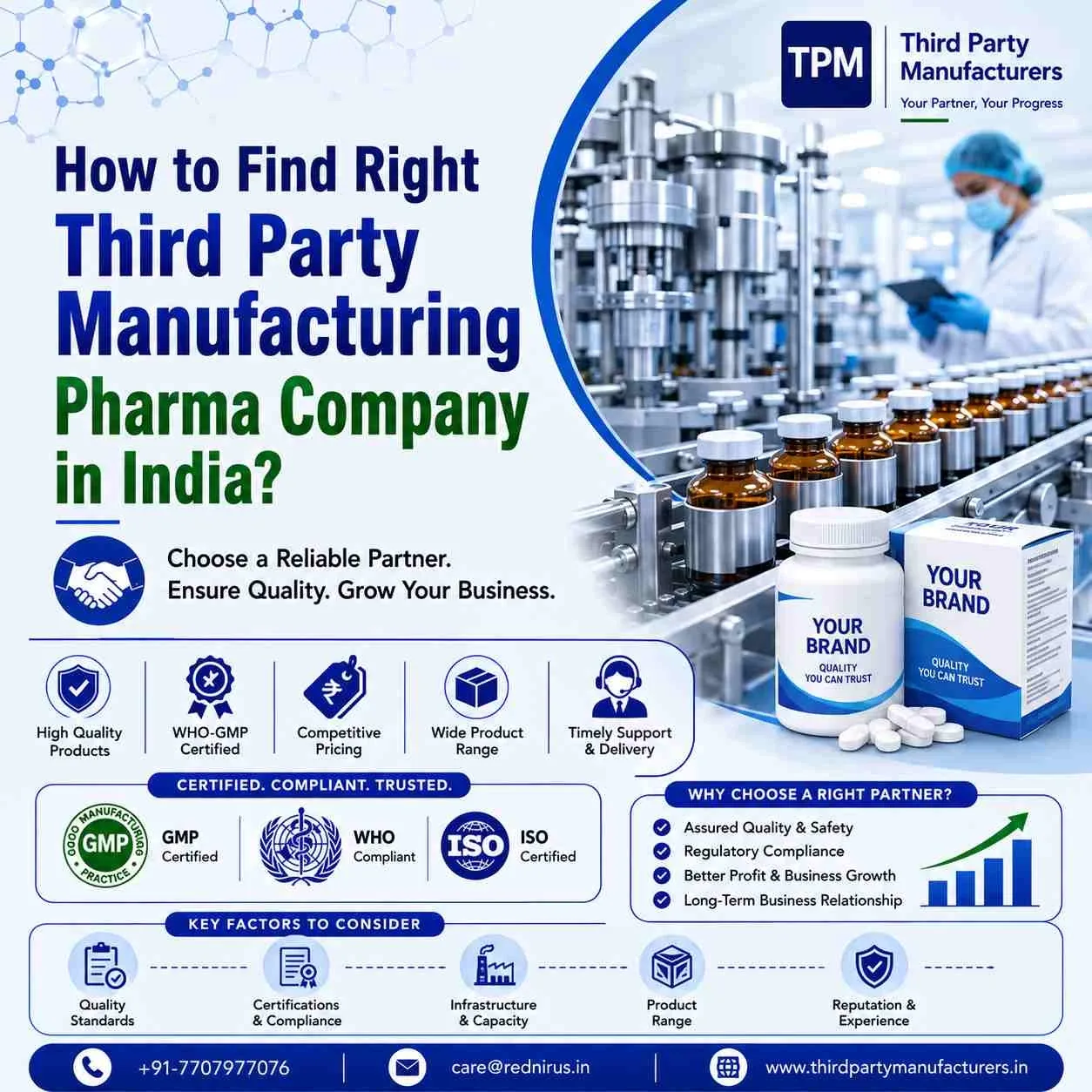
To find the right Third Party Manufacturing Pharma Company in India, look closely at its plant and product quality, and at its certificates and regulatory record. Then weigh up pricing and minimum order quantity, plus delivery timelines and the reputation it has built over the years with brands like yours. Verify licences and quality standards, compare a few manufacturers side by side, and go with the one that keeps meeting your product needs and your budget.
Sooner or later every pharma marketing company that wants a bigger product list asks the same thing. So does any brand trying to get to market faster. Who is actually going to make the product? This is where a contract manufacturer comes in. It takes on formulation and batch production along with quality testing. Marketing stays with the brand, as do distribution and doctor relations. India has a huge number of pharma plants, but not every unit can give you steady quality and on-time service. Picking the right Pharma Third Party Manufacturing Company isn't a casual decision. It shapes your product's image, its regulatory standing and how much money you make.
Key Statistics at a Glance
| Statistic | Latest Data |
|---|---|
| India's global rank by pharmaceutical production volume | 3rd |
| India's share of global pharmaceutical supply by volume | ~20% |
| Countries served by Indian pharmaceutical exports | 200+ |
| Indian pharma exports, FY 2025-26 | ~US$31.1 billion |
| Domestic pharmaceutical market, FY 2025-26 | ~US$60 billion |
| Projected domestic pharma market by 2030 | ~US$130 billion |
| Share of formulations & biologicals in pharma exports | ~74-75% |
| Global vaccine supply linked to India | ~60% |
| Global API industry share | ~8% |
| APIs manufactured in India | 500+ |
Understanding Third Party Manufacturing in the Indian Pharma Industry
The idea is simple. A pharma brand hires an established plant to make its medicines but keeps full control of branding and sales. The brand owner gives the formulation brief, or approves one the manufacturer suggests. The Third Party Manufacturers then buy raw material and make the product, and they pack it and test each batch under their own licences. For small and mid-sized brands entering the market this is now the default route. An in-house plant needs huge capital. It also needs WHO and GMP certification and a long list of legal steps.
It's not the same as job work. A proper contract maker takes responsibility for formulation stability and documentation, not just for turning out tablets because the brand asked.
You can think of the arrangement in two broad types. In plain Third Party Manufacturing, the unit makes an existing, ready formula under the brand's label with very little change. The second type is more of a joint effort. The manufacturer works with the brand's R&D inputs to build a different combination, strength or delivery format. Companies do this when they want to stand apart in crowded segments such as derma, ortho, gynae, critical care, cardiac diabetic and more.
How to Choose a Third Party Pharma Manufacturer?
| Factor | What to Check |
| Manufacturing License | A valid drug manufacturing licence |
| GMP Compliance | WHO-GMP or the GMP certificate that applies |
| Product Quality | Raw materials, testing, QC |
| Manufacturing Capacity | The dosage forms you need and batch capacity |
| MOQ | A minimum order quantity that suits your business |
| Documentation | COA and batch records, plus stability data |
| Pricing | Manufacturing + packaging + any other costs that apply |
| Delivery | Production and dispatch timelines |
| Reputation | Client references and track record in the market |
| Agreement | Written terms covering responsibilities and liabilities |
Why Businesses Choose Pharmaceutical Third Party Manufacturing Over In-House Production?
Building a plant to Schedule M and WHO GMP standards can take two to three years and a great deal of money. Outsource to established Third Party Manufacturing Pharma Companies and launch time drops to days. Pharma marketing firms benefit. So do PCD franchise companies and single-product outfits, which can try out new therapy segments without locking money into fixed assets.
Flexibility helps. You might use one unit for tablets and a different one for injectables, syrups or ointments, depending on your product line and the machines each plant has.
Predictable cost is an advantage people underrate. Manufacturing and QC are covered, packing too, by a per-unit rate agreed with the maker. So you can work out your margin without carrying the fixed costs of your own plant (machine repairs, wages, power and water bills) that don't shrink when an order is small. That's why Pharmaceutical Third Party Manufacturing suits products with seasonal or regional demand so well.
What Should You Check Before Choosing a Third Party Manufacturing Pharma Company?
Not every unit calling itself a contract maker can turn out compliant products batch after batch. Look at these points before you agree to anything.
- Licences and certificates. Check for valid WHO-GMP and GLP certificates and ISO 9001, plus an active state FDA manufacturing licence for the exact dosage form you need. A genuine 3rd Party Manufacturing unit shows you these papers. It doesn't just make promises.
- Capability and infrastructure. Visit the plant or ask for a video tour. Automatic packing machines and an in-house testing lab are good signs. So are separate areas for beta-lactam and non-beta-lactam production. Together they mark a mature unit rather than a stop-gap setup.
- Formulations and R&D help. A good maker helps you pick the right formula and get approvals for combination products. It should also have a bank of formulations that can be made under your brand name.
- Raw material supply. Ask where your APIs come from and whether the unit has a full product list. Uneven raw material quality is the most common reason batches fail at contract units that cut corners.
- Turnaround and communication. A great plant is no use if it can't deliver on time. See how well it keeps deadline promises and how quickly it answers your queries. That's usually a fair preview of life after you sign and start placing repeat orders.
Regulatory Compliance Checklist for Pharmaceutical Contract Manufacturing Companies
Pharma in India runs under close watch from state and central drug authorities, and any Third Party Contract Manufacturing deal has to reflect that. Before you sign, verify the following.
The plant should hold a properly maintained licence to make medicines under Schedule M of the Drugs and Cosmetics Rules 1945. Good contract units that export also keep COPP records, which says something about their quality standards.
Batch manufacturing records and stability data should be on hand for every product you order, along with the Certificate of Analysis. Good makers share them fast. Being open here protects both sides if there's ever a dispute or a regulatory audit.
Check too whether the unit has faced product recalls or show-cause notices, or been blacklisted by a state drug control authority. This shows up in FDA public records. Look it up before any long-term contract.
Packaging rules get missed by a lot of companies. Every label must carry the correct manufacturing licence number, the generic name in the prescribed font size and the batch details required under the Drugs and Cosmetics Act. A dependable partner points out any labelling gap before printing. The alternative is the brand owner finding a compliance problem after the stock is already with stockists.
How to Identify Top Pharma Contract Manufacturing Companies in India?
There are many contract units in Baddi, Panchkula, Ahmedabad and Hyderabad. Shortlisting them takes more than a Google search. To spot the leading Pharma Contract Manufacturing Companies , check references from their current franchise partners and look at how old the unit is and what name it has. Also see whether it already supplies established pharma marketing brands with a real market presence.
B2B pharma portals make this much easier. thirdpartymanufacturers.in is a B2B pharma marketplace that connects brand owners with manufacturing units across India. You can compare several contract makers in one place without cold calling or relying only on word of mouth.
Price isn't everything. When one maker quotes far below the others in the same category, it's often skimping on raw material quality or compliance papers. You only find out once the product is in the market.
Red Flags to Watch Out for While Selecting a Manufacturing Partner
Some warning signs tell a safe partner from a risky one. Be wary of a unit that won't share its licences or let you visit. Very fast turnaround promises with no proper testing time are another. So are vague answers on where raw material comes from. Any of these points to an unreliable setup.
Watch out, too, for makers who won't give a written agreement covering minimum order quantities and payment terms, and who's liable if quality complaints come up. A professional Third Party Pharma Manufacturing tie-up always rests on clear paperwork. Verbal assurances aren't enough.
A quieter red flag is a maker that dodges questions about its clients or won't name a single brand it supplies. Units that have been in this trade a long time hand out references happily. Their reputation is what keeps clients coming back.
Frequently Asked Questions
Q1. What is the difference between Third Party Manufacturing and Loan Licensing?
Ans: In third party manufacturing the maker uses its own licence and produces under an agreement. In loan licensing the brand owner uses the maker's infrastructure under the brand's own licence, so the brand carries more of the regulatory and compliance load.
Q2. How much time will it take to get a product launched via Third Party Manufacturing?
Ans: Once formulation and packaging design are settled (and the documents), most units can deliver the first batch in three to five weeks. It depends on how complex the product is, whether raw material is available and how many orders the factory already has.
Q3. Is it necessary to make a visit to the manufacturing unit before making any agreement?
Ans: Yes, visit in person or virtually. It confirms the unit really exists and isn't only on paper.
Choose your contract maker on regulatory compliance, manufacturing capability, product quality, documentation, MOQ, pricing, delivery record and reputation. Not on price by itself. Always check the manufacturer's credentials and papers before you sign.
Conclusion
Choosing the best contract partner is one of the biggest calls a pharma business makes. It affects product quality and regulatory standing, and your name with customers, for years. Look past the sales talk and check the licence and the plant yourself, along with every credential. Thirdpartymanufacturers.in makes this easier through its B2B pharma portal, which lists reliable units that have already been verified. Whether it's general medicines or specialised lines for a Pharma Franchise Company, so much rides on the maker you pick.
Must Read: Low MOQ Ayurvedic 3rd Party Manufacturing in India: A Guide for Startups
Why Businesses Choose Pharmaceutical Third Party Manufacturing Over In-House Production?
This not only helps the pharma marketing company, but PCD franchise companies, as well as individual product companies, to explore various therapeutic categories without investing in a fixed capital structure. To find the right Third Party Manufacturing Pharma Company in India, evaluate its manufacturing facilities, product quality, certifications, regulatory compliance, pricing, minimum order quantity, delivery timelines and reputation.
To find the right Third Party Manufacturing Pharma Company in India, evaluate its manufacturing facilities, product quality, certifications, regulatory compliance, pricing, minimum order quantity, delivery timelines and reputation. Verify licenses and quality standards, compare multiple manufacturers and choose a company that consistently meets your product, budget and business requirements. The pharma marketing companies looking to expand their product list, just like any pharma brand chasing faster market entry, eventually face the same question: who should actually manufacture the product? And that is when the Third Party Manufacturing Pharma Company plays a vital role, taking responsibil...
Key takeaways
- Key Statistics at a Glance
- Understanding Third Party Manufacturing in the Indian Pharma Industry
- How to Choose a Third Party Pharma Manufacturer?
- Why Businesses Choose Pharmaceutical Third Party Manufacturing Over In-House Production?
- What Should You Check Before Choosing a Third Party Manufacturing Pharma Company?
- Regulatory Compliance Checklist for Pharmaceutical Contract Manufacturing Companies
How to order Find Right Third Party Manufacturing Pharma Company in India
- Define the product Fix the composition, dosage form, pack size, quantity and your brand name.
- Shortlist manufacturers Compare WHO-GMP certification, product permission, capacity and location.
- Compare quotations Ask for the per-unit rate, MOQ, lead time and packing material cost in writing.
- Approve artwork and sample Finalise label, carton and MRP, and approve the pre-production sample.
- Receive your batch Pay the agreed advance and receive goods with invoice and certificate of analysis.