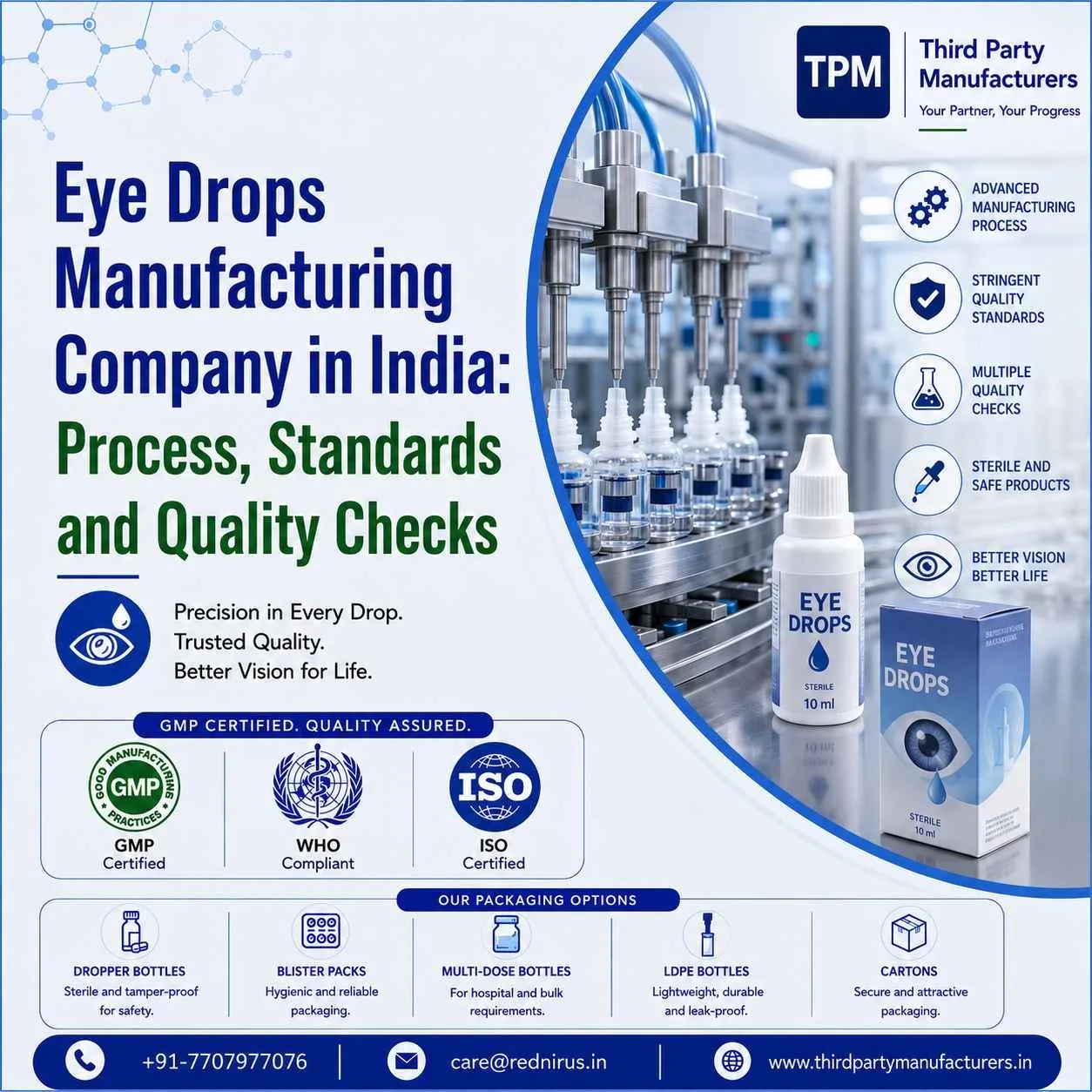
An Eye Drops Manufacturing Company in India makes sterile ophthalmic solutions under a tightly controlled process. It starts with purified water systems and moves through aseptic filling and sterilisation to sealed, secure packing. The work follows GMP and ISO along with the regulator's quality rules, and every batch is tested hard for safety and sterility, then for stability, before it goes out to the market.
Eye drop makers are a key part of India's pharma trade. They turn out safe, sterile, effective solutions for dry eyes, infections, glaucoma and allergies. Demand for low-cost eye care keeps rising at home and in export markets, and India has become a big supplier of eye drops to the world. Strict regulation and modern infrastructure made that possible. If you're picking a manufacturer, you need to understand how eye drops are made, which rules apply and how testing works, because every bottle has to be safe to put in a patient's eye.
What Does an Eye Drops Manufacturing Company in India Do?
Such a company formulates sterile ophthalmic solutions and makes them. It also tests and packs them. Oral tablets and capsules carry little contamination risk. Eye drops go onto a very delicate organ. So all Eye Drops Manufacturers in India are expected to keep sterility and formulation control at a very high level.
Their product lists usually cover lubricating drops and antibiotic drops, anti-allergic drops and anti-glaucoma solutions, plus combinations of these. Some run an eye and ear drops portfolio. Ophthalmic and otic formulations get made in the same facility with shared cleanrooms, since both need the same high sterility. A good unit generally holds WHO-GMP and ISO certification along with DCGI approved licences, and has its own R&D and quality control labs.
Beyond production, these companies often give brand partners the regulatory documents and artwork approvals, plus stability testing, needed for domestic sale and export registration. That full package is one big reason brands now prefer a single established eye drops maker over juggling one vendor for formulation and others for filling and packing.
Step by Step Process of Eye Drops Manufacturing in India
Eye Drops manufacturing involves several stages before the liquid ever reaches the bottle. At each one the goal is the same. Keep it sterile, and keep the API concentration right.
Formulation and Compounding
First the APIs are mixed in a compounding vessel with excipients: buffering agents and preservatives, tonicity modifiers, viscosity modifiers. The pH has to match natural tear fluid. Get it wrong and the drops sting.
Sterile Filtration and Filling
Next the solution is sterilised by membrane filtration and filled into pre-sterilised bottles in a Grade A cleanroom. Automated filling lines keep human contact low and batches consistent. A good plant will always have them.
The bottles are then closed with tamper-proof caps, labelled with batch number and expiry date, and boxed. Packing materials are tested as well, to confirm they're fit for use with the product.
Quality Standards Followed by Ophthalmic Drops Manufacturers in India
Makers of ophthalmic drops in this country follow a set of national and international quality standards. There's no room for shortcuts. Eye tissue reacts badly to any contamination, and a poor-quality product leads straight to infections.
- WHO-GMP (Good Manufacturing Practices) certification for the facility
- Schedule M under the Drugs and Cosmetics Act for sterile manufacturing units
- ISO 9001 and other ISO certifications for quality systems
- Product approvals from the DCGI (Drugs Controller General of India)
- Sterility testing and endotoxin testing, along with particulate matter analysis, on every batch
Ophthalmic products manufacturers are also expected to validate their cleanroom classification and check microbial load through environmental sampling. They have to keep full batch manufacturing records too, so any batch can be traced back during an audit or a recall.
Many go further. Some get certified by international bodies so they can export to regulated and semi-regulated markets. Stability studies under accelerated and long-term storage conditions prove that potency and clarity hold, and that the product stays sterile, right through its shelf life.
How to Choose the Best Eye Drops Manufacturers in India?
Price is only one part of it. Before you sign anything, look at certification and manufacturing capacity, at how strong the R&D team is, and at the plant's compliance history over the last few inspections, because a unit that keeps getting observations from the drug inspector will give you trouble later.
- Verify WHO-GMP and ISO certificates and the DCGI licence, along with recent audit reports.
- Check which formulations the maker can produce. Ask about combination and speciality drops too.
- Assess the cleanroom classification and what the in-house QC lab can actually test.
- Review timelines for custom formulation work and help with regulatory paperwork.
A dependable eye drops unit also keeps you informed during production. It shares the certificate of analysis and stability data for every batch that goes to your distributors or franchise partners.
Eye Drops Third Party Manufacturing and Pharmaceutical Third Party Manufacturing
Contract manufacturing of eye drops is the route companies take when they want ophthalmic products without building a sterile plant of their own. The brand gives its formulation and labelling needs to the partner. The partner does the rest.
Pharma third party manufacturing is the wider idea. Under it, Third Party Manufacturers of every kind make tablets, capsules, liquids and other medicines for client brands. A contract maker for ophthalmic products has one extra skill. It knows how to run a sterile line, and eye drops can only be made on one.
Entry costs drop sharply here. New pharma companies planning to enter eye drops can cut them by working with an established maker on a third party basis, and still get GMP-compliant products ready for market.
An experienced partner fills the gaps in your own formulation know-how, such as preservative-free single-use vials or lubricant drops meant for long-term use. Most contract makers also give you some flexibility on minimum order quantity and offer private labelling.
Building a List of Eye Drops Manufacturers in India
Before choosing anyone, a brand planning an eye drop range should draw up a shortlist. A well-researched list of eye drops makers in India can be sorted by what each one specialises in: anti-infective drops, lubricants, anti-glaucoma drops, or the combined eye and ear range.
Comparing makers gets much easier once you have their facility audit reports and samples in hand. References from other franchisees and distributors of their range help too.
FAQs
Q1. Which certifications are required for Eye Drops Manufacturing Company?
Ans: The company should hold WHO GMP and ISO 9001, follow Schedule M, and have a DCGI manufacturing licence. These show that it meets sterile and quality control standards and is licensed to produce ophthalmic products in India.
Q2. Is Eye Drops Third Party Manufacturing safe for pharma companies that want to make a new brand?
Ans: Yes, provided the maker is GMP certified. A new brand can launch quality-tested eye drops under its own name without setting up a cleanroom of its own.
Q3. How can I check the best manufacturers of Eye Drops in India?
Ans: Check the company's certifications. Ask for audit reports and test data, and speak to a few of its other clients.
Conclusion
India's growing name as the place to get eye drops made rests on the quality of its manufacturing network. Regulation is strict. Production costs stay low. Every stage of making eye drops runs under tight quality standards so the end user is safe. If you're looking at Eye Drops Third Party Manufacturing, or building a wider network of ophthalmic suppliers, put GMP compliance and real sterile manufacturing experience at the top of your checklist.
Read next Role of AI and Automation in 3rd Party Manufacturing in India
What Does an Eye Drops Manufacturing Company in India Do?
In an Eye Drops Manufacturing Company in India, the process includes formulation, manufacturing, testing, and packaging of the sterile ophthalmic solutions. Unlike oral tablets and capsules that can be administered with little risk of contamination, eye drops are used on a very sensitive organ.
An Eye Drops Manufacturing Company in India produces sterile ophthalmic solutions through a controlled process that includes purified water systems, aseptic filling, sterilization and secure packaging. Manufacturing follows GMP, ISO and regulatory quality standards, with rigorous testing to ensure product safety, sterility, stability and consistent quality before market distribution. Eye Drops Manufacturing Company is an important part of India’s pharmaceutical industry because of its ability to manufacture safe, sterile and efficacious eye solutions to cure dryness of the eyes, infections, glaucoma and allergic conditions. With rising demand for economical eye care solutions in India and th...
Key takeaways
- What Does an Eye Drops Manufacturing Company in India Do?
- Step by Step Process of Eye Drops Manufacturing in India
- Quality Standards Followed by Ophthalmic Drops Manufacturers in India
- How to Choose the Best Eye Drops Manufacturers in India?
- Eye Drops Third Party Manufacturing and Pharmaceutical Third Party Manufacturing
- Building a List of Eye Drops Manufacturers in India
How to order Eye Drops Manufacturing Company in India: Process, Standards and Quality Checks
- Define the product Fix the composition, dosage form, pack size, quantity and your brand name.
- Shortlist manufacturers Compare WHO-GMP certification, product permission, capacity and location.
- Compare quotations Ask for the per-unit rate, MOQ, lead time and packing material cost in writing.
- Approve artwork and sample Finalise label, carton and MRP, and approve the pre-production sample.
- Receive your batch Pay the agreed advance and receive goods with invoice and certificate of analysis.