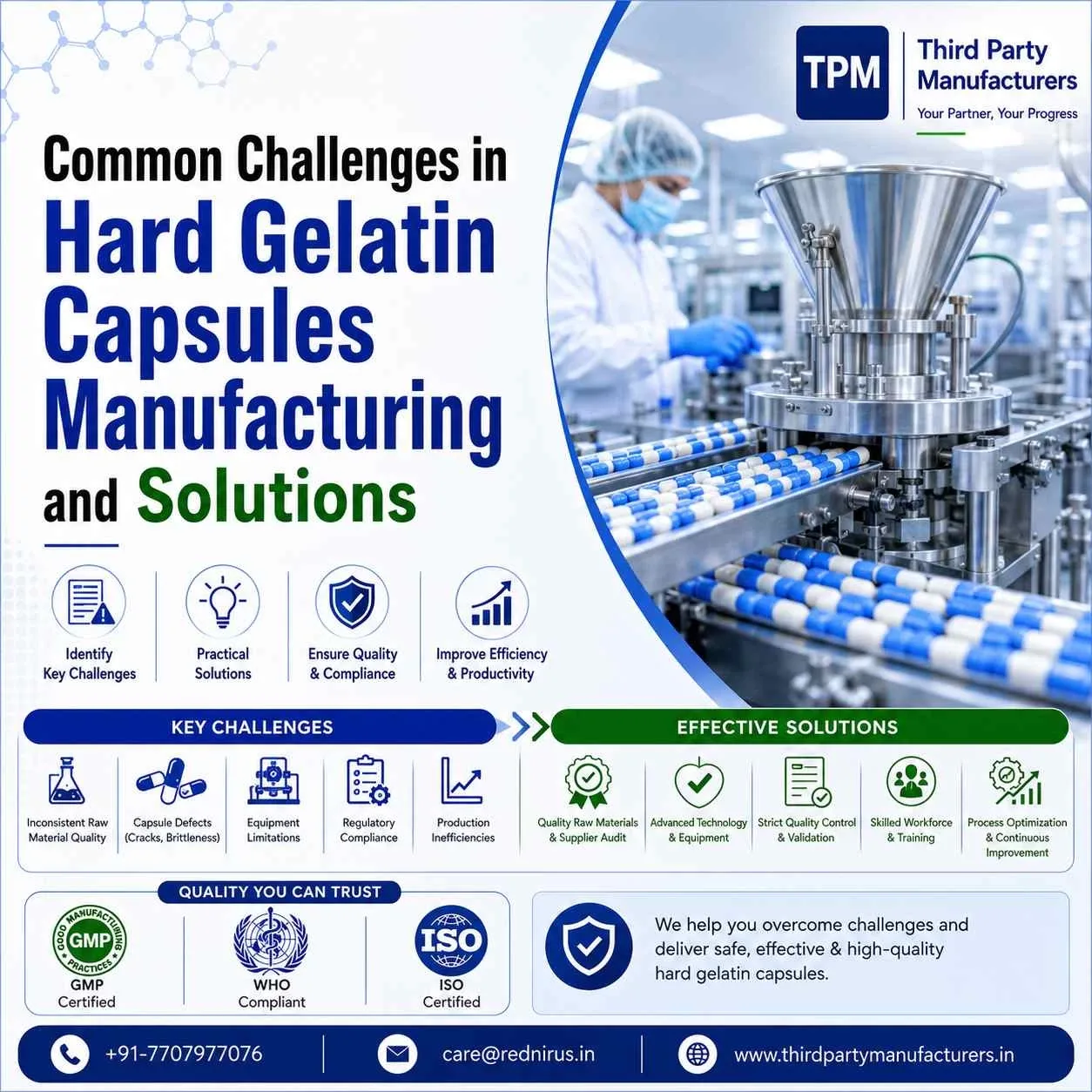
Hard gelatin capsule manufacturing runs into problems like wrong fill weights, broken shells, too much or too little moisture, and poor sealing. Most of these shrink once you use good raw material and keep production conditions under control. Regular machine upkeep and strict quality checks do the rest, and you get capsules that behave the same batch after batch.
Hard Gelatin Capsules Manufacturing is one of the most used methods in pharma. Dosing is accurate. A bad taste gets masked, and the active ingredient stays protected from moisture and sunlight. Demand for oral solids keeps growing in India and abroad, so drug companies and hard capsule makers face more pressure on consistency and quality, and on compliance as well. Still, the Manufacturing of Hard Gelatin Capsules has its weak spots, and risk creeps in at almost every stage. Below we go through the problems that come up most often on the shop floor, and how plants deal with them.
What is Hard Gelatin Capsules Manufacturing and Why Does It Matter?
The job has two parts. First you make two-piece shells, mostly from gelatin and water with some colour added. Then you fill them with powder, granules or pellets carrying the API. Compared with tablets, capsules break down quickly, often give better bioavailability, and patients find them easier to swallow. Capsule Manufacturers need special machines to turn out shells of even thickness and size, with the right strength, which are then filled and sealed under set conditions. Dip-moulding and drying have to work in step with joining. Only then do the shells meet Pharmacopoeia limits for weight and hardness, and pass dissolution.
Why care about the process? Because product stability depends on it, and so do shelf life and patient safety. If humidity drifts, or temperature, or the raw material isn't up to the mark, the Hard Gelatin Capsule Manufacture can go wrong and the end product is lost. Catch problems early. A capsule unit that spots a drifting hygrometer or a soft gelatin lot on day one saves itself a rejected batch, a recall scare and an angry client on day ten.
Key Challenges Faced in Hard Gelatin Capsule Production
1. Raw Material Variability
Gelatin from different suppliers, and even from different batches of the same supplier, comes with different bloom strength and viscosity, and the moisture content varies too. That changes shell thickness and solubility, so the capsules coming out of Capsule Manufacturing Companies are not always alike. A small change of supplier can give you brittle shells that fail disintegration tests. Gelatin comes from collagen in hides and bones, and that supply is seasonal. Small producers without long-term supply agreements feel this the most.
2. Sensitivity to Moisture and Temperature Changes
Hard gelatin shells react to their surroundings fast. High humidity makes them soft and sticky. Low humidity makes them brittle, and they crack. Holding the room in a narrow 35 to 45% RH band is a constant headache for gelatin capsule manufacturers who don't have modern HVAC. In much of India the monsoon makes it harder still, since the air can swing from dry to soaking wet within a week and the AHU has to keep up.
3. Capsule Filling Weight Variation
Keeping the fill weight even when a line turns out millions of capsules an hour is still one of the toughest parts of the job. Powder that doesn't flow well, weak granulation or a wrong machine setting can leave capsules under-filled or over-filled, and then the dose is off.
4. The Dangers of Cross-Contamination
Plants that run several products, including those doing Capsule Contract Manufacturing, carry a higher risk of cross-contamination. Without proper cleaning validation, allergens or actives can carry over from one product into the next.
5. Brittleness and Cracking of Shells
Capsules that dry out too much crack in transit and in storage. Staff at capsule plants mention this often, mostly for consignments going to places where the climate is very different from the plant's.
6. Regulatory and Compliance Pressures
Compliance is its own burden. You have WHO-GMP and Schedule M, along with DCGI guidelines. Capsule makers must keep proper documents and validate their processes, with traceability at every step, and if this isn't built into daily work it slows production down. Rules change often. A Pharma Capsule Manufacturer has to keep its staff trained on the latest updates to stay compliant.
7. Machine Downtime and Maintenance Problems
High-speed encapsulation machines run round the clock. A broken die, a misaligned pin or an electrical fault can stop the line. When that happens without warning and you're working to a tight deadline, it hurts badly.
Proven Solutions to Overcome Hard Gelatin Capsules Manufacturing Challenges
Standardizing Raw Material Sourcing
Buy from pre-qualified, WHO-GMP certified gelatin suppliers and test every gelatin lot for bloom and viscosity. Hard Gelatin Capsule Production units that do this see far less variation between batches.
Climate Controlled Facilities Investments
Modern encapsulation plants now run automatic humidity and temperature control inside the encapsulation rooms. Keep conditions steady through the whole Production of Hard Gelatin Capsule cycle and shell defects drop while yield goes up.
Upgrading Filling Machinery and Calibration Protocols
Calibrate dosing pumps and auger-fill machines on a schedule. Add in-process weight checks every fifteen to twenty minutes, and the fill weight stays inside acceptable limits.
Implementing Strict Cleaning Validation
For contract capsule units, the fix is dedicated lines for high-risk products plus validated cleaning-in-place procedures. Together they remove the risk of one client's batch contaminating another's.
Better Packaging and Storage Procedures
Aluminium blister packs with desiccant, and humidity control in the warehouse, cut shell brittleness for Pharmaceutical Capsule Manufacturers both in storage and on long trips.
E-Batch Recordkeeping
Electronic batch manufacturing records and an automated quality management system help Pharma Capsule Manufacturing companies stay audit ready. Paperwork errors largely disappear.
Implementation of Preventive Maintenance Plans
Inspect dies and pins on a fixed schedule, check the vacuum equipment, and keep spare parts in stock. Then a breakdown doesn't turn into days of lost production.
Why Softgel and Soft Gelatin Capsule Manufacturers Share the Same Challenges?
This post is mainly about hard capsules, but softgel makers face much the same trouble with gelatin quality and humidity, and with accurate filling. On top of that, a soft gelatin unit has to encapsulate liquid or semi-liquid fills. Soft gelatin production follows many of the same quality rules as hard shell work, including close watch on the environment and standard raw material.
Many firms offering Soft Gel Capsule Contract Manufacturing today run one quality programme for both hard and soft capsule lines. So a single GMP-approved plant can serve pharma clients and nutraceutical clients side by side.
If you're a new pharma brand, check whether the plant you're considering has made both dosage forms. It's a fair test of what it can do. A Soft Gelatin Capsule Manufacturer that also runs hard shell lines has usually built tighter quality processes, because its departments have had to work closely together.
FAQs
Q1: What is the major problem faced by Hard Gelatin Capsules Manufacturing process?
Ans: Humidity control. The gelatin shell is very sensitive to moisture changes, and during production this can cause cracking or weak shells, or capsules that start dissolving too early.
Q2: What can Capsule Manufacturing Companies do to avoid variation in fill weight?
Ans: Calibrate the machines, keep granule size uniform, and weigh samples regularly while the batch runs. Automated filling equipment that checks fill weight on its own also helps.
Q3: Are Capsule Manufacturing Companies safe from cross-contamination?
Ans: Yes, if the plant uses validated cleaning and keeps dedicated equipment for certain products, with batches kept apart during production. Good capsule makers also run swab tests on their lines regularly to prove they're clean.
Conclusion
Good hard capsule work depends on precision and on constant control of the room conditions. The trade does face problems with raw material variation and humidity, with fill weight accuracy and with contamination. All of them can be solved. Work with well-trained gelatin capsule makers who use modern equipment and you'll get consistent capsules.
If you're looking at capsule manufacturing as a business, hunting for a contract partner, or comparing quotes from soft gel units, go with a WHO and GMP certified company. Pharma and nutraceuticals are both moving fast. The makers who fix problems before they happen, not after, will hold the best position in the market.
Read next White Label Pharma Manufacturing vs Third Party Manufacturing: Key Differences
What is Hard Gelatin Capsules Manufacturing and Why Does It Matter?
Manufacture of Hard Gelatin Capsules consists of manufacturing two part hard capsule shells mainly composed of gelatin, water and colours, which later get filled with powders, granules, and pellets with Active Pharmaceutical Ingredients. Compared to tablets, capsules ensure quick disintegration, higher bioavailability, and easier swallowing by patients.
Hard gelatin capsule manufacturing can face challenges such as filling inaccuracies, capsule breakage, moisture imbalance, and sealing defects. These issues are reduced through quality raw materials, controlled production conditions, regular equipment maintenance and strict quality checks, ensuring consistent capsule performance, product safety and reliable pharmaceutical manufacturing. Hard Gelatin Capsules Manufacturing is one of the most popular methods in the pharmaceutical sector due to its high accuracy in dosing, masking of bad taste and protection from moisture and sunlight for active ingredients. With increasing demand for oral solid dosage forms in India and other markets around th...
Key takeaways
- What is Hard Gelatin Capsules Manufacturing and Why Does It Matter?
- Key Challenges Faced in Hard Gelatin Capsule Production
- Proven Solutions to Overcome Hard Gelatin Capsules Manufacturing Challenges
- Why Softgel and Soft Gelatin Capsule Manufacturers Share the Same Challenges?
How to order Common Challenges in Hard Gelatin Capsules Manufacturing and Solutions
- Define the product Fix the composition, dosage form, pack size, quantity and your brand name.
- Shortlist manufacturers Compare WHO-GMP certification, product permission, capacity and location.
- Compare quotations Ask for the per-unit rate, MOQ, lead time and packing material cost in writing.
- Approve artwork and sample Finalise label, carton and MRP, and approve the pre-production sample.
- Receive your batch Pay the agreed advance and receive goods with invoice and certificate of analysis.