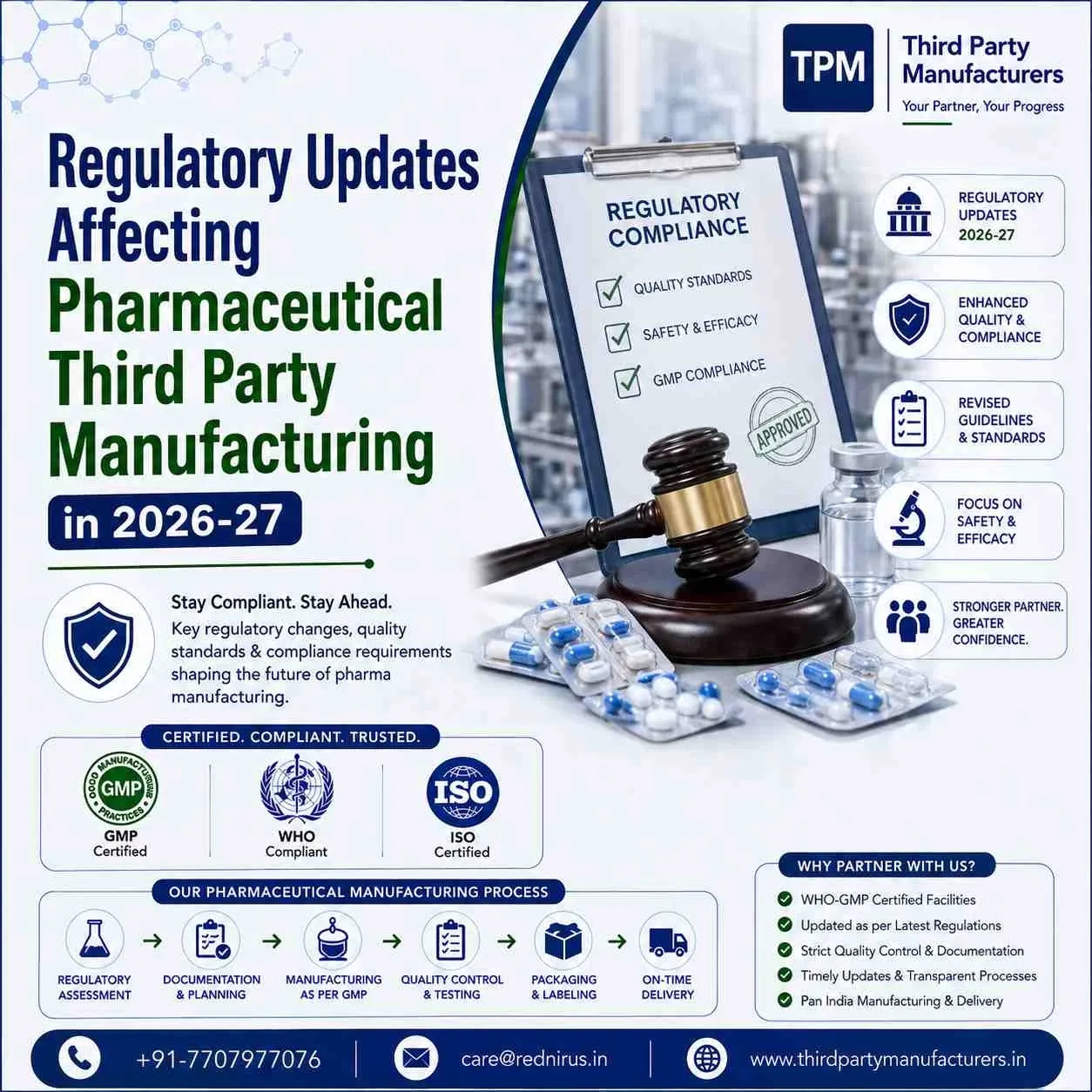
Regulatory updates affecting pharmaceutical third party manufacturing in 2026-27 bring tighter compliance and closer regulatory oversight, along with stricter rules on quality control and documentation, and on manufacturing standards. Companies have to follow the updated rules on product quality, licensing, labelling and testing, plus Good Manufacturing Practices (GMP), if they want to stay compliant and keep production safe and consistent.
Contract manufacturing of medicines is heading into a strict phase. India is changing the rules on drugs and facilities, and on the paperwork behind them. Loan licensing and outsourcing have already seen big changes in the last few years. In 2026-27 the way third party manufacturers work with brand owners and distributors will shift again. Everyone in the outsourcing business needs to follow what's happening, from the new Schedule M to fresh licensing and traceability rules. That goes for a pharma marketing company that gets its products made outside. It goes just as much for the manufacturer doing the job.
What Pharmaceutical Third Party Manufacturing Mean in Today's Regulatory Climate?
Put simply, a brand owner hires a licensed plant to make medicines under the brand owner's name. This model built India's pharma franchise and PCD trade over many years. A marketing-led company could enter the market without spending crores on a factory. The Pharma Third Party Manufacturing Company holds the licences and GMP certificates and owns the equipment. The brand owner looks after sales and marketing.
What's different now, in 2026-27, is how much responsibility regulators put on both sides. Brand owners are no longer treated as passive buyers. They are expected to make sure their manufacturers hold valid licences, follow Schedule M and keep batch records in order.
Key Regulatory Changes Affecting Third Party Pharma Manufacturing Companies
Revised Schedule M and Plant Upgrades
The new norms are coming in phase by phase. Third Party Manufacturing Companies have to upgrade. That means better ventilation and validated equipment, computer-based documentation, a proper QC lab. Small units used to soft enforcement will have to upgrade or lose their manufacturing licence. You can already see it happening. Some units have merged. Others have simply shut down the plants that were never going to meet the new benchmark, however much paperwork they tidied up.
Licensing & State Inspections
State drug authorities are inspecting more often. If a unit is caught with outdated documents, a lapsed certificate or poor storage, production can be suspended. For brands this matters a great deal. A manufacturer's record follows your product into the market and hits your reputation along with theirs.
Digital Traceability and Barcoding Norms
Track-and-trace rules used to cover mainly export formulations. Now they're spreading to many domestic products. Third party manufacturing products more and more need QR codes or barcodes tied to batch data, so distributors (and even patients) can check that a strip or bottle is genuine. The aim is to stop counterfeit medicines. It also adds compliance cost, and both the maker and the brand owner need to budget for it.
Quality Standards Every Third Party Manufacturing Pharma Company Must Meet
The quality bar for Pharmaceutical Contract Manufacturing has gone up on many fronts. To stay relevant, a unit has to follow WHO-GMP guidelines and buy raw material through a validated process. Every batch needs proper stability testing. Regulators are also looking much harder at how contract units handle deviations and recalls, and at change control records, because past compliance failures usually started there.
Big players are automating. That slowly raises the entry barrier for new contract units. It also gives brand owners who rely fully on outsourced production a market they can trust more.
How to Identify the Best Third Party Manufacturing Companies in India?
With the rules getting tougher, picking the Best Third Party Manufacturing Companies in India isn't just about price per unit anymore. Look for a unit that's open about its licence status and happy to share recent inspection reports. Modern production lines matter as well. The strongest partners are usually the ones that have already moved to the revised Schedule M framework and can show a clean record over the last few audit cycles.
A few checks worth doing before you sign the contract:
- Confirm the manufacturing licence and GMP certificates are valid and actually cover the products you're outsourcing
- Visit the plant and look at the storage area, the testing lab and the packing section
- Speak to past clients and find out if the unit has had any recalls or regulatory warnings on its products
- Get clarity on what documentation support you'll get during state and central drug authority inspections
A list like this keeps you clear of sudden production stops caused by a partner's non-compliance. Those hurt far more than paying a little extra per strip.
Growth Outlook for top Third Party Pharma Manufacturers in India
Compliance is tighter, yet demand for contract units isn't slowing. Many analysts actually expect the market to grow, because plants that are established and compliant look safer to brand owners who want to stay out of regulatory trouble. Companies hunting for a 3rd Party Manufacturer now lean towards pharma clusters like Baddi, Panchkula, Ahmedabad and Hyderabad, where infrastructure has been upgraded for the new standards.
Contract manufacturing is also moving into newer therapy segments such as nutraceuticals and dermatology. Speciality injectables are another. Brands want variety in their range without carrying the manufacturing risk themselves. For anyone willing to set themselves apart by being properly compliant, 2026-27 is an interesting time.
Frequently Asked Questions
Q1. Do all Third Party Manufacturers need to comply with the revised Schedule M norms?
Yes. They apply to every licensed manufacturing unit, including those working on loan licence or third party terms, whatever their size or location in India.
Q2. How will the brand owner ascertain the compliance status of the manufacturing company?
Ask for copies of current licences, the GMP certificate and inspection reports. You can also confirm the licences with the State Drug Control Department concerned.
Q3. Would these regulations have any cost implications on the cost of doing business in Pharma Contract Manufacturing?
Costs will rise a bit. But lower recall risk and fewer production breaks, plus a stronger brand, should make up for it.
Conclusion
The 2026-27 rules for third party manufacturing push the whole sector to be more accountable and to document what it does. For brand owners, choosing a partner becomes as important as product strategy. Manufacturers will have no option but to keep up with Schedule M changes and inspections, and with traceability norms. The companies that treat this as a chance to build trust (not as a hurdle) are the ones likely to lead India's contract pharma trade in the years ahead.
Must Read: Private Label Skin Care Manufacturers in India: MOQ, Pricing & Packaging Guide
What Pharmaceutical Third Party Manufacturing Mean in Today's Regulatory Climate?
Third Party Pharmaceutical Manufacturing means hiring a license production facility that will produce medicines for a brand owner using its own brand name. This business model is what helped India's pharmaceutical franchising and PCD sectors flourish for many years because it allows companies focused on marketing to enter markets without spending crores to develop their own manufacturing facility.
Regulatory Updates Affecting Pharmaceutical Third Party Manufacturing in 2026-27 include stricter compliance, quality control, documentation, manufacturing standards, and regulatory oversight. Companies must follow updated requirements for product quality, licensing, labelling, testing and Good Manufacturing Practices (GMP) to maintain compliance and ensure safe, consistent pharmaceutical production. The time has come for Pharmaceutical Third Party Manufacturing to see an era of stringent regulations as India implements changes in regulations concerning drugs, facilities and documentation. The last few years have seen significant changes being made with regard to regulations in the field of...
Key takeaways
- What Pharmaceutical Third Party Manufacturing Mean in Today's Regulatory Climate?
- Key Regulatory Changes Affecting Third Party Pharma Manufacturing Companies
- Revised Schedule M and Plant Upgrades
- Licensing & State Inspections
- Digital Traceability and Barcoding Norms
- Quality Standards Every Third Party Manufacturing Pharma Company Must Meet
How to order Regulatory Updates Affecting Pharmaceutical Third Party Manufacturing in 2026-27
- Define the product Fix the composition, dosage form, pack size, quantity and your brand name.
- Shortlist manufacturers Compare WHO-GMP certification, product permission, capacity and location.
- Compare quotations Ask for the per-unit rate, MOQ, lead time and packing material cost in writing.
- Approve artwork and sample Finalise label, carton and MRP, and approve the pre-production sample.
- Receive your batch Pay the agreed advance and receive goods with invoice and certificate of analysis.