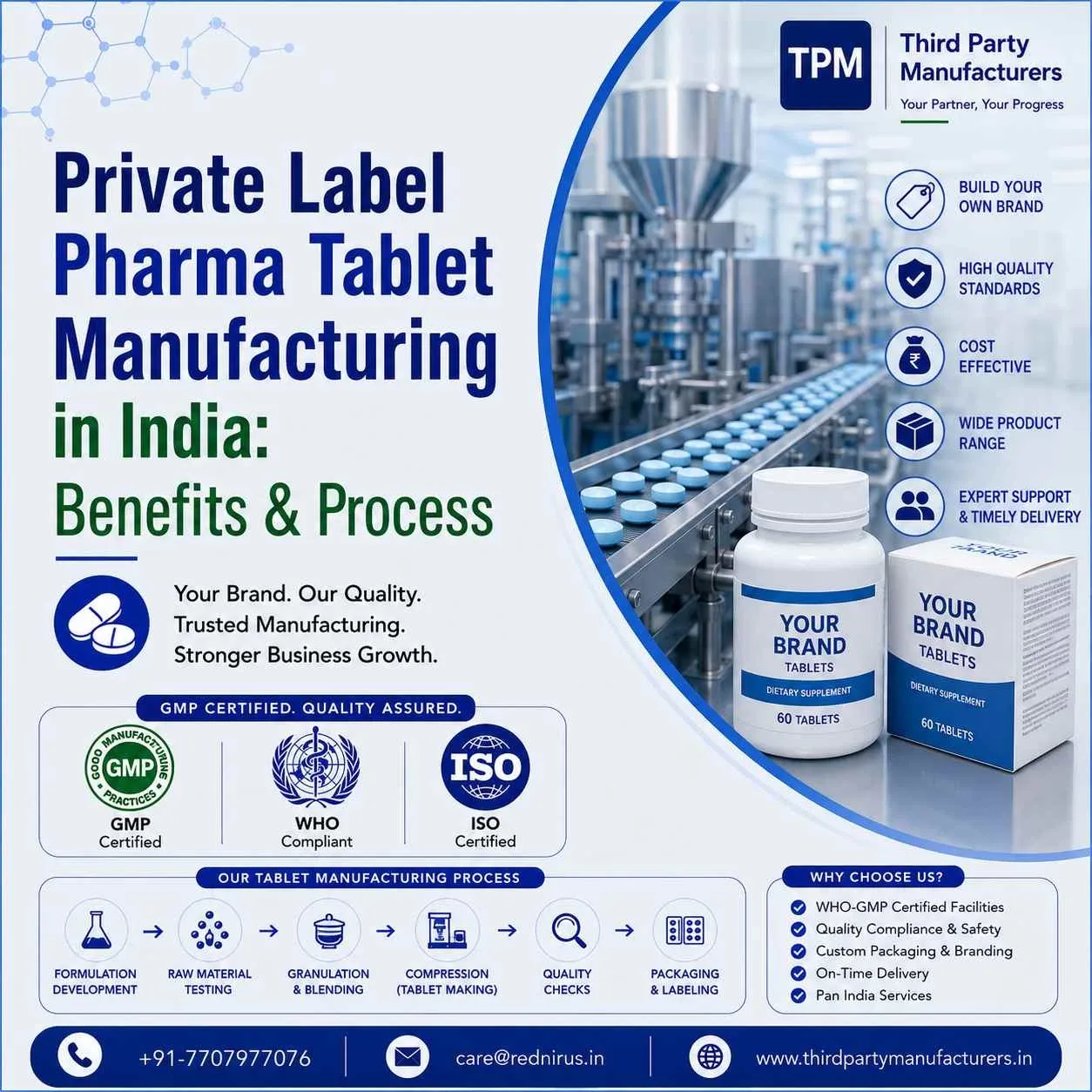
Private Label Pharma Tablet Manufacturing in India lets a business sell tablets under its own brand while a certified manufacturer does the production. The work starts with product selection and formulation. Then come the regulatory papers, the actual manufacturing and the packing, and quality testing closes it out. You save on cost and reach the market faster, and quality stays consistent from one batch to the next.
Tablet manufacturing has become one of the fastest growing parts of India's healthcare industry. Domestic demand keeps climbing and export openings keep widening. More and more entrepreneurs and distributors, along with healthcare firms, now team up with leading Tablets Manufacturers to build brands of their own without spending on infrastructure or approvals. The trade calls it private label. You work with an experienced tablet unit that already holds WHO-GMP and DCGI approvals. Maybe you're a new company looking for a maker, or a large distributor hunting for the best tablet unit. Either way, knowing how private label works will help you make decisions that pay.
What is Private Label Pharma Tablet Manufacturing?
The tablet is marketed and sold under your company's brand name, on your strips and in your cartons. The actual production is done by a professionally run Tablet Manufacturing Company. No plant. No machines to buy, and no technical staff on your payroll. You pick formulations from the maker's product list and get them packed under your own name and pack design.
This model sits at the heart of India's pharma distribution for PCD franchise holders and retailers, and for exporters too. In private label mode the brand owner keeps full control of marketing and sales. All the technical work stays with the manufacturer.
Key Benefits of Working with Private Label Tablet Manufacturers
Partnering with established Private Label Tablet Manufacturers has several advantages, which is why the model appeals to new and existing pharma entrepreneurs alike. Setting up a plant takes a long time. Instead, you plug into an existing network of tablet makers and spend your energy on building the business. The main benefits are these.
- Low investment, high returns. You don't need a plant or costly machinery. The manufacturer takes care of all that.
- Quality control. Working with WHO-GMP and DCGI certified tablet makers gives you consistent quality and stability across all batches, and safe product every time.
- Quick launch in market. Ready formulations and running production lines mean you can enter the market in weeks, not months.
- Extensive range. A good tablet unit will offer a big list, including antibiotic, analgesic, cardiac, neuro, dermatological and nutraceutical tablets.
- More attention on marketing. With manufacturing handled, you can put far more of your time into selling.
Step by Step Process of Manufacture of Pharmaceutical Tablets
Brand owners should know how tablets are made, even roughly. It shows you which quality checks happen before your product reaches the market. A licensed tablet unit normally works like this:
- Raw material procurement. APIs and excipients are bought from trusted suppliers whose material has been tested.
- Granulation. The powder blend is turned into granules so it flows well.
- Compression. Automated tablet presses compress the granules into tablets of the required shape and size, at the right hardness.
- Coating. Tablets may get a sugar or film coat to mask taste, improve looks or control release.
- Quality control tests. Every batch goes through dissolution and disintegration tests. Hardness is checked. So is weight variation.
- Packaging and labelling. Approved tablets are packed in blister packs or bottles and labelled to your private label requirement.
- Dispatch. Finished stock goes to the brand owner or straight to distributors, as per the agreed logistics plan.
How to Identify the Best Tablet Manufacturing Company?
With so many tablet makers in India, choosing one can feel hard. It isn't, really. Go for a company that is certified under WHO-GMP and ISO, carries approval from the DCGI, and can show you a clear product list with its range and prices printed against each item, so you know what you're comparing before the first meeting.
The better makers have a proper QC lab and deliver on schedule. They're flexible on minimum order quantity, and they help with marketing material like visual aids and MR bags, even catalogues. Ask for product samples, read what other clients say, and visit the plant if you can. Those are the sensible steps before you pick a partner.
Compare pricing and payment terms too, plus after-sales service, before you close any deal. A good tablet unit will hand over its drug licences and GMP certificates, and product test reports, the moment you ask, and won't mind putting things in writing. Find out as well whether it can handle regulatory paperwork for state and export licences. That alone saves a lot of time when you apply for a new drug licence or start exporting.
Why India is a Global Hub for Pharma Third Party Manufacturing Company Partnerships?
India is now one of the biggest and cheapest places in the world to outsource medicine production. Indian tablet units gain from lower production costs and skilled labour. There are the Baddi clusters in Himachal Pradesh as well, home to hundreds of WHO-GMP certified units. So India suits both domestic brand owners and overseas buyers looking for a reliable contract partner.
Global interest in affordable generics has added to India's standing among the best Pharmaceutical Tablet Manufacturers. Many units already export to regulated and semi-regulated markets in Africa and Southeast Asia, and in Latin America under third party agreements.
Cost is half the story. India's regulatory system has improved a great deal over the last decade. Stricter enforcement of Schedule M pushed many Pharma Tablets Manufacturers to upgrade their plants to international level. Working with a contract maker for export-ready stock is far easier now, since most Indian units keep the documents that WHO and EU-GMP rules ask for, and other export systems too.
Contract Tablet Manufacturer vs Third Party Medicine Manufacturer
People often use the two terms as if they mean the same thing. There are small differences though. A Contract Tablet Manufacturer makes tablets from the formula the brand owner provides, under a manufacturing agreement. A third party medicine maker offers ready formulations from its own product basket, and the brand owner picks some and rebrands them.
In most cases a Third Party Manufacturer in India can do both, and you choose which service you want. Call it contract or third party, it doesn't matter much. The aim is the same: efficient production for your pharma brand.
Before you engage any contract tablet maker, draw up a manufacturing and supply agreement. Cover price terms and delivery deadlines. Put quality assurance in it, and a clause on keeping your formulas confidential. It protects you and your partner from misunderstandings later.
Frequently Asked Questions
Q1. Is Private Label Tablet Manufacturing Legal in India?
Ans. Yes. The DCGI and the State Drug Control Acts regulate it, provided the manufacturer holds valid WHO-GMP and drug manufacturing licences.
Q2. What is the minimum order quantity for private label tablets?
Ans. It varies by maker and by product, but usually it runs into thousands or even lakhs of tablets per batch, depending on the press size and the strip or blister format you choose.
Q3. How long will it take to launch private label tablets?
Ans. If you go with an existing tablet unit and its ready formulations, you can launch your private label tablets in four to six weeks.
Conclusion
Private label tablet manufacturing has opened the door for many entrepreneurs and distributors to enter India's growing pharma industry without a plant of their own. Work with an experienced maker that holds proper licences and you get quality-assured products and monopoly business openings, while you concentrate on sales and branding. India is now one of the best places to outsource pharma goods. Choosing the right manufacturing partner is the one decision that decides how far your business goes.
Read next Eye Drops Manufacturing Company in India: Process, Standards and Quality Checks
What is Private Label Pharma Tablet Manufacturing?
Private label tablet manufacturing is a concept where the tablet is marketed and sold under the brand name of a company, whereas the production part is done by a professionally operated Tablet Manufacturing Company. Private Label Pharma Tablet Manufacturing in India allows businesses to market tablets under their own brand while outsourcing production to a certified manufacturer.
Private Label Pharma Tablet Manufacturing in India allows businesses to market tablets under their own brand while outsourcing production to a certified manufacturer. The process includes product selection, formulation, regulatory compliance, manufacturing, packaging and quality testing, offering cost efficiency, faster market entry and consistent product quality. Pharma Tablet Manufacturing has now emerged as one of the quickest-growing sectors in the healthcare industry of India because of increasing demand from the domestic market and increased export opportunities all around the world. Increasingly, entrepreneurs, distributors, and healthcare companies are collaborating with leading Tabl...
Key takeaways
- What is Private Label Pharma Tablet Manufacturing?
- Key Benefits of Working with Private Label Tablet Manufacturers
- Step by Step Process of Manufacture of Pharmaceutical Tablets
- How to Identify the Best Tablet Manufacturing Company?
- Why India is a Global Hub for Pharma Third Party Manufacturing Company Partnerships?
- Contract Tablet Manufacturer vs Third Party Medicine Manufacturer
How to order Private Label Pharma Tablet Manufacturing in India: Benefits & Process
- Define the product Fix the composition, dosage form, pack size, quantity and your brand name.
- Shortlist manufacturers Compare WHO-GMP certification, product permission, capacity and location.
- Compare quotations Ask for the per-unit rate, MOQ, lead time and packing material cost in writing.
- Approve artwork and sample Finalise label, carton and MRP, and approve the pre-production sample.
- Receive your batch Pay the agreed advance and receive goods with invoice and certificate of analysis.