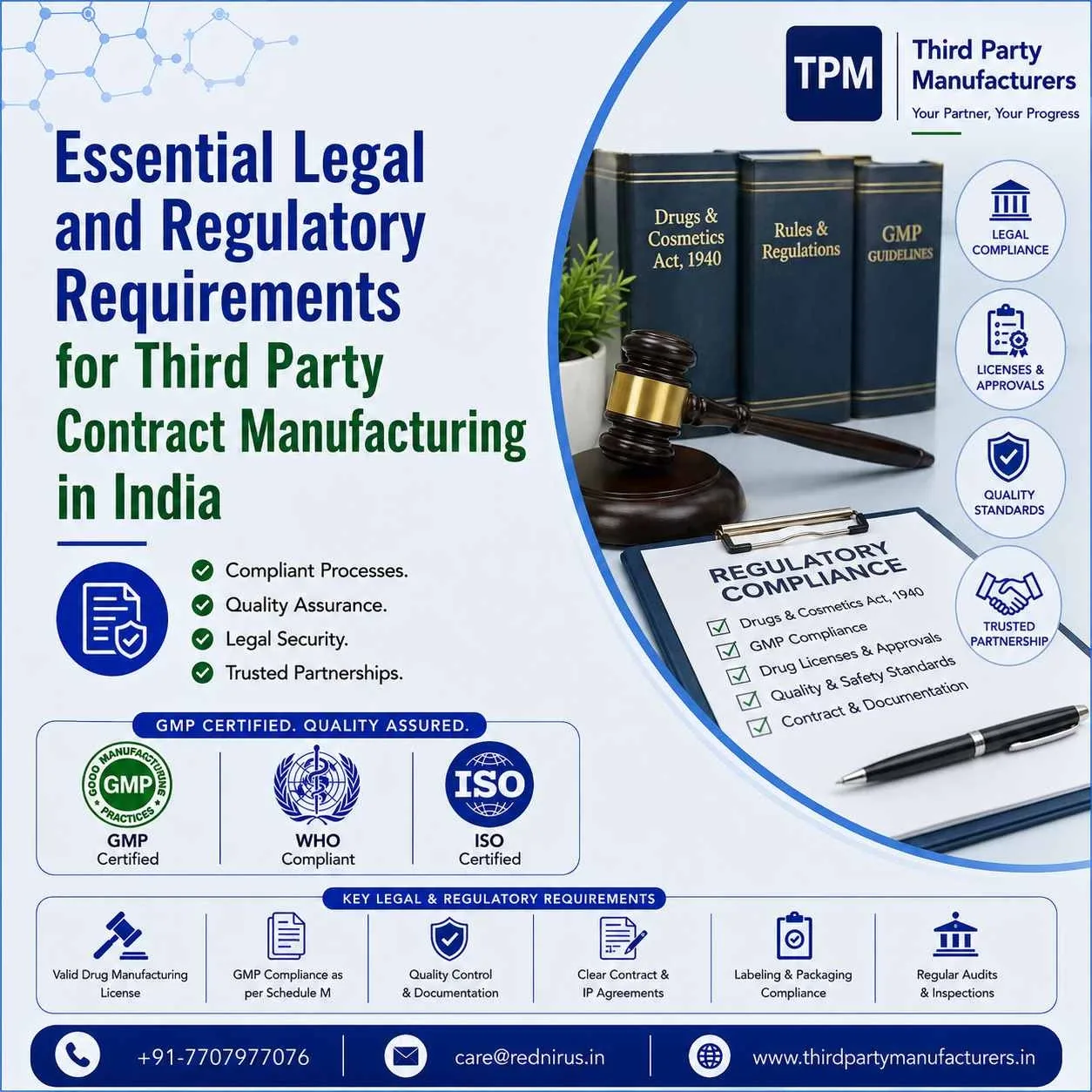
The main legal and regulatory requirements for Third Party Contract Manufacturing in India start with a valid manufacturing licence and Good Manufacturing Practices (GMP). You also have to meet CDSCO rules and the Drugs and Cosmetics Act, keep quality documents in order, and follow labelling and safety standards. Get these right and you stay on the legal side. Approvals come easier.
Third Party Contract Manufacturing has become one of the fastest growing business models in Indian pharma. Brand owners get their products made without putting up a plant. Demand from Tier 2 and Tier 3 cities keeps rising, and many entrepreneurs now see contract manufacturing as a low-investment way to enter the market with a product range of their own under a trusted brand. The model only works if both sides clearly understand the legal setup, though. Pharmaceutical Contract Manufacturing in India comes under strict laws. They cover licensing and quality, labelling, even the terms of your contract. This blog walks through the legal requirements every brand owner or manufacturer should know before starting third party work in India.
What is Third Party Contract Manufacturing?
First, the arrangement itself. Put simply, the brand owner works with an experienced 3rd Party Manufacturer Company that makes medicines on its behalf, using the brand owner's formula and packing, under the brand owner's name. Production is the manufacturer's job, and so are packing and testing. The brand owner markets and sells the medicines.
This isn't a loan licence deal, where the brand owner holds its own manufacturing licence and only uses another company's plant. In third party pharma manufacturing, everything to do with production and the plant's regulatory compliance sits with the manufacturer. The brand owner answers for its quality claims and for compliance in the market.
Brand owners usually go this way for tablets, capsules, syrups, injectables, ointments and Ayurvedic products, because it removes the need for big spending on plant and machinery. Instead of sinking crores into a unit, a newcomer can launch dozens of SKUs within a few weeks by tying up with an existing, properly licensed maker. PCD pharma franchise outfits like the model a lot. So do distributors moving into Tier 2 and Tier 3 cities.
Key Licenses and Legal Requirements for Pharma Contract Manufacturing Companies
Licensing comes first. Working with an unregistered or wrongly registered Contract Manufacturing Company is probably the worst legal trouble a brand owner can walk into.
Pharma Products Manufacturing License under Schedule M
Every contract maker must hold a valid manufacturing licence under the Drugs and Cosmetics Act, 1940. It must also meet Schedule M rules on plant layout and equipment. Those rules go further, into documentation and the quality control system. As brand owner, always check that the licence is valid before you place an order.
Registration under GST and Trademark Registration
Valid GST registration is needed for tax and for billing from the manufacturer to the brand owner. On top of that, the Third Party Medicine Manufacturer arrangement should have the brand name and logo properly registered as a trademark. Otherwise copycats can imitate you once the product is out in the market.
Labelling & Packaging
Labels on products made this way must follow the rules framed under that same Act. They need the manufacturing licence number and batch number, the date of manufacture and expiry date, and the composition. Both names go on too, the manufacturer's and the marketing company's. Missing or wrong label details are among the most common reasons products get rejected during inspections. So both parties should sign off on the artwork before production starts.
Quality Certifications Required by Pharmaceutical Contract Manufacturing Companies
A licence alone won't do. Quality certifications tell you whether a maker follows production and testing standards accepted worldwide.
Certification for WHO-GMP and ISO Compliance
Most well-known Contract Manufacturing Companies now hold WHO-GMP (Good Manufacturing Practices) certification. It proves the plant has been assessed on hygiene and equipment calibration, and on production documentation, against global standards. ISO certification adds to this by keeping the quality management system consistent batch after batch.
Certificate of Pharmaceutical Product (CoPP)
If you want to export, or sell to governments through tenders, you need a Certificate of Pharmaceutical Product issued by the drug authority. It shows the product is made and marketed as per Indian regulations. Overseas buyers usually ask for it before importing 3rd Party Manufacturing Pharmaceuticals from India. Planning to sell abroad? Find out early whether your maker holds an active CoPP for that formulation.
Legal Agreement and Compliance Checklist before Partnership
A well-drafted agreement protects the brand owner. It protects the manufacturer too, and keeps both clear of legal trouble later. Before you tie up with a third party maker, the contract should cover:
- Formulation and packaging rights, plus intellectual property rights
- Minimum order quantity and prices
- Quality control responsibilities and batch testing protocols
- Recall procedures and liability if a product turns out defective
- Confidentiality clauses to protect proprietary formulations
- Termination conditions and how disputes will be settled
Skip any of these and you're taking on serious legal risk, more so if a quality complaint comes up after the product is already in the market.
Plenty of small brand owners still run on a verbal deal or an informal purchase order with their contract partner. They think trust covers it, and for a while it does, until a batch fails a test in some state lab and nobody can agree on who pays for the recall. Regulators and courts will want it, and even banks will ask for a written agreement when there's a licensing issue, a GST audit or a dispute to settle.
How to Identify Top Pharma Contract Manufacturing Companies in India?
Thousands of units offer third party manufacturing services, so proper due diligence before signing matters a great deal. If you want a genuine, compliant partner, start with a physical visit to the plant and check that its licence is valid with the State Drug Authority. Then look at these:
- WHO-GMP and ISO certificates, and CoPP documents where needed
- Track record with other brand owners and the range of its product portfolio
- Openness about raw material sourcing and batch documents
- Willingness to share sample agreements and quality assurance reports
Shortlisting Top Pharma Contract Manufacturing Companies takes effort. That care saves you from licensing problems later and keeps mistakes away, which matters most for people new to this market who are setting up a PCD or franchise business.
Watch for red flags. A company that won't share its drug licence numbers, won't let you inspect the plant, quotes prices far below the trade average, or can't explain its batch testing is one to avoid. Honest manufacturers have nothing to hide.
Frequently Asked Questions
Q1: Is a manufacturing license required for the brand owner in case of third party manufacturing?
Ans: No. In pure third party manufacturing the licence stays with the manufacturer. The brand owner must still register its trademark and get the approvals needed to market the product.
Q2: Which certifications should I look for while deciding on a manufacturer?
Ans: Always check the WHO-GMP certificate and the Schedule M manufacturing licence, plus the Certificate of Pharmaceutical Product where it applies. Together they show the maker meets quality and safety norms.
Q3: Can there be early termination of the contract between the brand owner and the third party manufacturer?
Ans: Yes, if the agreement spells out the early exit terms, such as notice period and finishing pending orders, and what happens to leftover packing material. Without those terms, ending early can get messy.
Conclusion
Contract work is a practical way into India's pharma sector, but only when it's built on legal compliance. Verify licences and WHO and GMP certification, and sign a solid manufacturing contract. Do that and your interests stay protected for years. You might be talking to a contract maker for the first time, or growing an existing franchise network. Either way, compliance beats shortcuts every time. Check the licences and certificates, get the agreement right, and you'll build a business that's legal and profitable.
As competition among contract makers grows, the ones who put time into legal checks and proper agreements will grow faster and run into fewer regulatory problems.
Read next Private Label Pharma Tablet Manufacturing in India: Benefits & Process
What is Third Party Contract Manufacturing?
Before proceeding to discuss the compliance issues, it would be essential to know about the arrangement itself. In plain language, the brand owner cooperates with an experienced 3rd Party Manufacturer Company in the Pharma industry to manufacture medications on behalf of the brand owner using the formula and packaging and brand name owned by the brand owner.
Essential Legal and Regulatory Requirements for Third Party Contract Manufacturing in India include obtaining valid manufacturing licenses, complying with Good Manufacturing Practices (GMP), meeting CDSCO and Drugs and Cosmetics Act regulations, maintaining quality documentation and following labeling and safety standards. These requirements help ensure legal compliance, product quallabellingity and regulatory approval. Third Party Contract Manufacturing has emerged as one of the fastest growing business models in the pharmaceutical industry in India, which makes it possible for brand owners to manufacture their products without having to set up any manufacturing plant. With rising demands f...
Key takeaways
- What is Third Party Contract Manufacturing?
- Key Licenses and Legal Requirements for Pharma Contract Manufacturing Companies
- Quality Certifications Required by Pharmaceutical Contract Manufacturing Companies
- Legal Agreement and Compliance Checklist before Partnership
- How to Identify Top Pharma Contract Manufacturing Companies in India?
How to order Regulatory Requirements for Third Party Contract Manufacturing
- Define the product Fix the composition, dosage form, pack size, quantity and your brand name.
- Shortlist manufacturers Compare WHO-GMP certification, product permission, capacity and location.
- Compare quotations Ask for the per-unit rate, MOQ, lead time and packing material cost in writing.
- Approve artwork and sample Finalise label, carton and MRP, and approve the pre-production sample.
- Receive your batch Pay the agreed advance and receive goods with invoice and certificate of analysis.